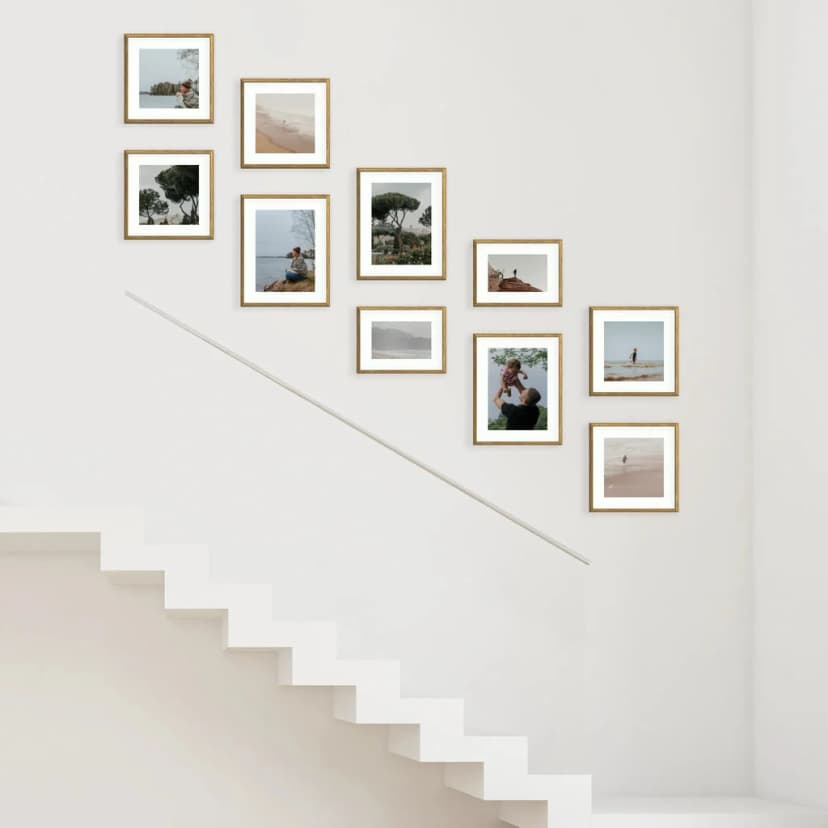
How to Hang a Photo Gallery Wall on Stairs
Hang a staircase photo gallery in about 15 minutes: measure the rise, pick a stepped layout, use Framky’s 1:1 template — no drill.
5 min read
Article
What science reveals about the impact of family and nature photographs on stress, mood and sense of belonging. Research review, mechanisms, and practical insights.
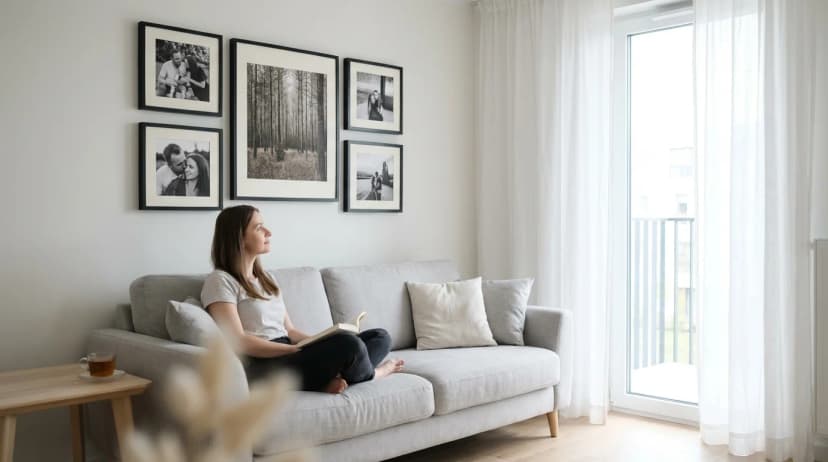
Quick answer: Research in environmental psychology shows that exposure to family photographs and nature imagery in domestic spaces is associated with lower perceived stress levels, stronger sense of belonging, and improved mood. The effects are not dramatic — they don''t replace psychological support or relationships with loved ones — but they are measurable and consistent across numerous studies since the 1990s. The strongest evidence concerns nature imagery (stress reduction) and family photographs (sense of belonging in children).
The question of whether wall photographs really make a difference or are merely decoration comes up regularly in conversations about photo gallery walls. Environmental psychology and social neurobiology offer a cautious but clear answer: yes, the presence of personalised images in the space where we live and work does influence our emotional functioning. Below is a review of the research, mechanisms, and limitations of this impact — with honest acknowledgement of where evidence is strong and where it is weaker.
Environmental exposure is a term in environmental psychology referring to passive, everyday engagement with elements of our surroundings — without conscious viewing. Photographs on the wall that you glance at whilst having your morning coffee and again before bedtime are a classic example. They differ from "task-based" exposure (consciously viewing a photo album) because they work involuntarily, without cognitive effort. It is precisely this "lack of effort" that makes the effects subtle yet long-lasting.
The strongest scientific evidence concerns nature imagery — landscapes, trees, water, animals. A summary of key findings:
Key principle: The mechanism behind the effect of nature imagery is called attention restoration — directed attention recovery. Nature images engage involuntary attention, freeing up the resources of focused attention that we expend at work.
What this means in practice. If you hang photographs of landscapes, trees, or water in your home office or bedroom — exposure to them during work or rest is a supportive, rather than neutral, element of the environment. This is not "magic", but a measurable attentional effect.
Here the evidence is weaker than with nature imagery, but consistent. Three mechanisms that researchers have identified:
Developmental research suggests that children in homes where family photographs are visible and recognisable show a stronger sense of family identity and narrative continuity. Duke and Fivush (2008) in their study The Do You Know Scale showed that children who know their family''s history — built in part through viewing photographs together — have higher emotional resilience and better stress management.
Social neurobiology shows that looking at photographs of people we know activates the hippocampus and prefrontal cortex in a way similar to actively remembering them. Cabeza and St. Jacques (2007) in Trends in Cognitive Sciences discuss how this activation also occurs with "fleeting" visual contact, without conscious recollection.
Here the evidence is most exploratory. Some studies (such as Master and colleagues, 2009, Psychological Science) suggest that merely thinking about close persons — including through visual contact with their photograph — may lower cortisol response to stress. The effect is small but statistically significant.
Key principle: Family photographs do not "cure" loneliness or depression. They are subtle emotional support for people who have healthy, secure relationships with the people pictured. They do not replace contact with loved ones.
| Photograph Type | Main Mechanism | Strength of Scientific Evidence | Recommendation |
|---|---|---|---|
| Natural Landscapes | Attention restoration | Strong | Home office, bedroom, rest spaces |
| Living Loved Ones | Sense of Belonging | Moderate | Living room, kitchen, children''s rooms |
| Deceased Loved Ones | Memory, Grief | Weak (depends on individual processes) | Cautiously; consult a professional if grief is recent |
| Travel Photographs | Identity Contextualisation | Weak but consistent with narrative theory | Hallways, entrance halls |
| Pet Photographs (own) | Analogous to loved ones | Moderate (research on pet owners) | Child''s room, anywhere |
| Abstract Images | Neutral | No effect in most studies | For decorative effect, not emotional |
Before moving to practical application, it is worth mentioning things that often appear in popular articles but lack strong scientific backing:
If you want to build a gallery with long-term psychological effect in mind — rather than purely decorative — consider four principles:
Habituation is a phenomenon in which the brain ceases to respond to a constant, unchanging stimulus. It also applies to wall photographs — after a few months of daily viewing you stop consciously registering what is in them. This does not mean the effect disappears (environmental exposure works independently of conscious registration), but conscious enjoyment of the gallery decreases.
Two ways to counteract this:
Honest acknowledgement of what this article does not establish:
Research suggests yes — but the effect is subtle and individual. The strongest evidence concerns sense of belonging in children and activation of autobiographical memory in adults. The effect does not work like a "medicine" — it is steady, gentle emotional support, available through involuntary visual contact with the gallery.
There is strong scientific evidence from environmental psychology research (Ulrich 1984, Kweon 2008, Berto 2005) that exposure to nature imagery — trees, water, landscapes — is associated with lower self-reported stress levels and faster attention recovery after cognitive effort. The effect works with images as well as real nature contact.
Yes, because of the sense of belonging mechanism. Research by Duke and Fivush (2008) shows that children who know their family''s narrative history — often built through viewing photographs together — demonstrate greater emotional resilience. Recommended: photographs of family, grandparents, parents'' childhood, favourite family places.
A photo gallery does not cure or prevent depression. Depression is an illness requiring specialist support — psychotherapy, possibly medication. Photographs may be one of many small, supportive elements in the environment, but they do not serve a therapeutic function.
Conscious registration of photographs fades within months through habituation (the brain adapts to constant stimuli). But the effect of environmental exposure — passive influence on mood and stress — works independently of conscious viewing. Changing 1–2 photographs once a year reactivates conscious attention.
This is deeply individual. For people in a stable grieving process, photographs of the deceased may support continuity of memory and connection. For people in acute grief or struggling with complicated grief, daily visual contact with such a photograph may be a source of suffering. If in doubt, speak with a psychologist — the decision should not be made "on general article advice".
If you are interested in which walls in your home are best for a gallery from a psychological perspective, read The Psychology of Photo Placement — guide on placement and room considerations. If you are still deciding whether a gallery makes sense for you, take the quiz in Is a Photo Gallery Right for Me? 7 Helpful Questions. After deciding, move to How to Plan a Photo Gallery Step by Step.
You can design a gallery matched to your home and emotions in the Framky configurator — MDF frames without glass, pigment printing with a set of 12 inks, and self-adhesive hangers making photo swaps effortless.
Sign up and we'll send you a code with a bigger discount than the shop offers — plus occasional inspiration for your photo gallery wall.
Hang a staircase photo gallery in about 15 minutes: measure the rise, pick a stepped layout, use Framky’s 1:1 template — no drill.
Hang a photo wall in the stairwell: measure the rise, pick a layout along the banister, use a 1:1 template. No drill, about 15 minutes.
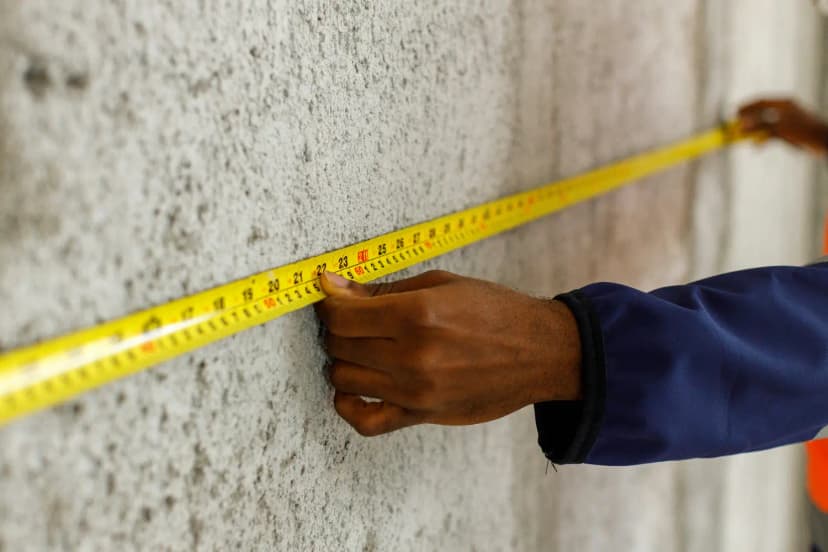
See gallery wall layouts with real sizes — 3, 5, 6, 8, 10+ frames. Match a Framky kit to your wall width, then hang with a 1:1 template.
Give it a try?
See how it works