Gallery Wall on a Sloped Ceiling: How to Hang Pictures in an Attic Room
Under a sloped ceiling, hang the gallery on the low knee wall or the gable wall, not on the slope. Heights, layouts and fixings for attic rooms.
6 min read
Article
Modern living-room wall — arrangement rules, a palette of black, white and oak, black-and-white compositions and inspiration. Concrete step-by-step tips.
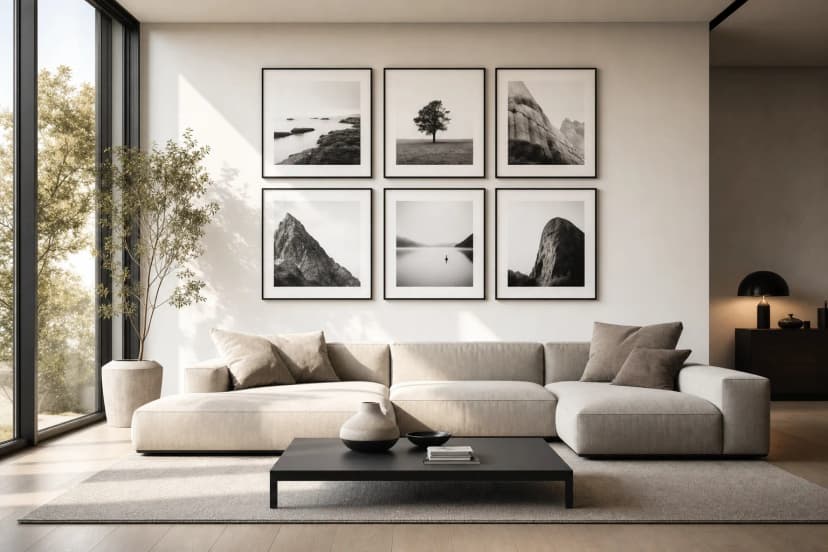
Short answer: A modern living-room wall rests on four principles: minimalism (fewer frames, larger formats), a consistent palette (black, white and oak), clean lines, and symmetry or deliberate rhythm. The strongest effect comes from a monochrome, black-and-white gallery in uniform MDF frames without glass — no light reflections and a single frame colour give the order a modern interior expects. Avoid an excess of small frames, mixing many colours, and saturated filters. In wall arrangement, modernity isn't about the number of elements but about discipline in choosing them.
You'll recognise a modern living room by what isn't in it: excess, randomness and visual noise. The same principle governs the wall. The most common mistake is treating modernity as a "novelties" style — flashy gadgets, neon, a collage of ten frames. In fact modernity is above all about order: a limited palette, clean lines and deliberate decisions.
In this guide we show the principles of a modern living-room wall arrangement, a colour palette that won't date, and concrete inspiration. At the end you'll find a "what to do / what to avoid" table and answers to the most common questions.
A modern wall arrangement isn't a matter of taste but of a few repeatable principles that separate an interior that's "orderly" from one that's "cluttered". Here are the four most important ones.
1. Minimalism — fewer, but larger. Instead of a gallery of 9–12 small frames, choose 1–4 large formats (40 × 60, 50 × 70 or 60 × 90 cm). Each element gets space to "breathe", and the wall doesn't overwhelm.
2. A consistent, limited palette. A modern living room sticks to 2–3 colours. In the context of the wall that means black, white and oak — both as frame colour and as the tone of the photos.
3. Clean lines and symmetry. Frames aligned to a common axis, even spacing (5–8 cm), no "scattered" elements. Symmetry isn't compulsory, but if you give it up, do so deliberately — for rhythm, not by chance.
4. Negative space. The empty space around the composition is part of the design, not its absence. A composition occupying 60–75% of the wall's width looks more modern than filling it completely.
Colour is what dates an interior fastest — which is why a modern wall sticks to a narrow, timeless palette. The three colours that won't age are black, white and oak (dark or light). These are the ones that dominate Scandinavian, minimalist and japandi arrangements.
In practice: frames in black give a strong outline and modern rigour, white — lightness and clarity, oak introduces warmth without breaking minimalism. All these colours are available in Framky's MDF profiles. Avoid mixing several frame shades in one composition — it's the first sign of an "unfinished" wall.
On the photo side, modernity is supported by restrained editing: natural colours or a full conversion to black and white. You'll find more on keeping a single colour line in the article colour consistency in your gallery.
If you had to choose one safe direction for a modern wall, it would be a black-and-white gallery. Converting photos to black and white solves two problems at once: it eliminates the colour mismatch between photos from different cameras and years, and it gives the composition a consistent, timeless character that doesn't age along with trendy filters.
The model solution looks like this: 3–4 black-and-white photos in uniform MDF frames without glass, a single frame colour (most often black or white), even spacing, the centre of the composition at eye level. The absence of glass is key here — a black-and-white photo with strong contrasts suffers particularly from light reflections, and a frame without glass shows the full depth of tones.
Remember the consequence of location for frames without glass: don't hang them in places exposed to water splashes or within reach of small children. In a living room above a sofa, though, it's the ideal spot. We've written more broadly about combining black-and-white and colour shots — it's worth choosing the convention deliberately at the design stage.
The wall behind the sofa is the most common place for a modern composition in a living room — and the most visible. A few proven layouts:
Whatever the layout, keep the composition within 60–75% of the sofa's width and leave 15–25 cm between the lower edge of the frames and the backrest. If you're combining frames of different sizes, check how to align frames of different sizes on the wall.
A modern effect comes from consistency in the details. The table below gathers the most important decisions.
| Element of a modern wall | How to do it | What to avoid |
|---|---|---|
| Number of frames | 1–4 large formats | A gallery of 9–12 small frames |
| Colour palette | Black, white, oak | A mix of 4+ frame colours |
| Frame colour | One colour for the whole composition | Different frame colours side by side |
| Photos | Black-and-white or restrained editing | Saturated "Instagram" filters |
| Composition | Symmetry or deliberate rhythm | Random scattering of frames |
| Spacing | Even 5–8 cm | Uneven, varying gaps |
| Finish | MDF frames without glass (no reflections) | Glossy glass reflecting light |
A modern effect is easy to ruin with crookedly hung frames or needless holes in a freshly painted wall. You'll hold lightweight MDF frames on self-adhesive hangers (included in the set) — without drilling. They won't damage the wall, provided the paint is firmly bonded to the plaster and the plaster is stable.
For larger formats there's a traditional option: 2 nails in the inner corners of each frame (nails not included). We print the photos using pigment printing with a set of 12 inks on matte photographic paper, on a rigid cardboard plate — which gives a flat, deep image, ideal for a minimalist, modern composition.
Go for minimalism: 1–4 large formats instead of many small frames, a limited palette (black, white, oak), a single frame colour for the whole composition and even spacing. The surest choice is a black-and-white gallery in MDF frames without glass above the sofa. The composition should occupy 60–75% of the wall's width.
Black, white and oak are a timeless base for a modern interior. Black frames give a strong outline, white — lightness, and oak introduces warmth without breaking minimalism. Avoid mixing many frame colours in one composition — it's the most common sign of an unfinished wall.
Yes — a black-and-white gallery is one of the surest choices for a modern living room. Conversion to black and white eliminates the colour mismatch between photos and gives the composition a timeless character that doesn't age along with trendy filters. It looks best in uniform frames without glass.
Less is more. A modern wall is usually 1–4 large formats, not a gallery of a dozen or more small frames. One large 60 × 90 cm frame or two 50 × 70 cm formats side by side give a stronger, more contemporary effect than a dense grid of small photos.
Frames without glass don't reflect light from windows and lamps, so the photo is seen clearly from every angle — which underlines the minimalist, orderly character of a modern interior. The matte photographic paper gives a deep colour without gloss. Remember, though, not to hang them within reach of water and small children.
It doesn't have to be, but it should look planned. Symmetry (e.g. two equal formats side by side) is the safest, but deliberately broken symmetry works well in lofts and industrial interiors. The key is aligning the frames to a common axis and even spacing — it's about rhythm, not chance.
If you're planning a modern wall in line with current directions, start with gallery wall trends 2026, and then take care of colour consistency in your gallery. When combining different formats, how to align frames of different sizes on the wall will help. For more on why modern compositions look best without glass, see the quality without glass section.
You can design a modern, black-and-white gallery in uniform MDF frames without glass in the Framky configurator — you have over 1,000 ready-made layouts to personalise.
Sign up and we'll send you a code with a bigger discount than the shop offers — plus occasional inspiration for your photo gallery wall.
Under a sloped ceiling, hang the gallery on the low knee wall or the gable wall, not on the slope. Heights, layouts and fixings for attic rooms.
Treat the TV as one frame: centre the gallery on the screen, align edges, keep equal gaps and use larger frames near it. Four layouts that work.
Autumn wall decorations without new frames: swap 2–3 photos in the gallery for forest, misty mountains, night sky and winter photographs from Framky Artists. How many to change, which palette, and when to return to the spring set.
Give it a try?
See how it works