
How high should pictures hang?
Hang the centre of a picture or a group about 145–150 cm above the floor. Heights above a sofa, a bed, a dresser and on the stairs.
3 min read
Article
Find out what your wall is made of first, then pick the right fixing for concrete, plasterboard, brick or plaster. Or skip the drill on sound paint.
Find out what the wall is made of before you buy any fixings. Plasterboard sounds hollow and needs a picture hook or a hollow-wall anchor. Concrete and brick need a masonry drill bit and a wall plug. Old plaster needs a small pilot hole so it does not crack. Light frames without glass can skip the drill on sound, well-bonded paint with self-adhesive hangers.

In October 2026 we read 435 forum threads and 2,728 comments about photo gallery walls from the UK, the US, Germany, the Netherlands and Poland. Questions about hooks, nails, drills and wall types were the most common topic: they came up in 39% of all threads. In the Netherlands it was 53%, in the UK 45% and in Germany 44%.
The same stories repeat in every language:
Plaster, wallpaper and plasterboard are the wall surfaces named most often in thread titles, followed by concrete and brick. Almost every one of these problems starts with not knowing what is behind the paint.
Use three quick tests. You only need a pin and, if you have one, a drill.
| Test | Plasterboard (drywall) | Plaster on brick or block | Concrete | Brick (bare or painted) |
|---|---|---|---|---|
| Knock with a knuckle | Hollow, drum-like sound | Solid, dull sound | Solid, very hard | Solid |
| Push a pin in | Goes in easily | Goes in a little, then stops | Will not go in | Will not go in |
| Colour of drill dust | White, soft powder | White or grey, then red or grey | Fine grey, very hard to drill | Red or orange (sand-lime brick: white) |
| Typical home | New builds, partition walls, loft rooms | Older houses, most solid walls | Apartment blocks, large-panel buildings | Older houses, feature walls |
Before you drill, check for cables and pipes with a detector. Do not drill directly above or below sockets and switches, because cables often run straight up or down from them.
Plasterboard is a thin gypsum board on a frame of studs, with an air gap behind it.
Always check the load rating on the fixing packet and stay well under it.
Concrete is the hardest common wall, and the reason nails bend.
If the drill stops dead on metal, you have probably hit reinforcement. Stop and move a few centimetres.
Plaster covers brick or block in most older homes. In some period houses it sits on wooden laths instead.
Wallpaper is a surface, not a wall. Find out what is behind it with the tests above, then use the matching fixing. Do not use self-adhesive hangers on wallpaper or woodchip paper. The paper can lift as a sheet and come away with the frame.
Framky frames are MDF without glass. The largest size, 50 x 70 cm, weighs up to 900 g. That makes them light enough for self-adhesive hangers on a sound wall. The kit includes the hangers and a 1:1 paper template.
| Wall surface | Self-adhesive hangers | Otherwise |
|---|---|---|
| Painted plasterboard, paint well bonded | Yes | Picture hooks or hollow-wall anchors |
| Painted concrete, paint well bonded | Yes | Masonry bit and wall plugs |
| Smooth painted plaster, stable | Yes | Pilot hole and wall plugs |
| Bare or rough brick | No | Masonry bit and wall plugs |
| Wallpaper or woodchip paper | No | Fixing that matches the wall behind |
| Peeling, chalky or fresh paint | No | Wait for the paint to cure, or drill |
Self-adhesive hangers do not damage the wall when the paint is firmly bonded to the plaster and the plaster is stable. If your wall fails a 24-hour test on a hidden patch, hang each frame on 2 nails in the inner corners instead (nails and screws are not included). The full no-drill method is in hanging photo frames without drilling.
Many re-measuring stories end with extra holes. Tape a 1:1 template to the wall, mark every hanging point through it, and only then drill or stick. Every Framky kit comes with one, so the layout is decided before the first hole.
How do I know what my wall is made of? Knock on it, push a pin in, and look at the drill dust. A hollow sound and white powder mean plasterboard. A solid sound and red dust mean brick. A pin that will not go in and fine grey dust mean concrete.
Can I hammer a nail into a concrete wall? Usually not. Ordinary nails bend in concrete. Use a hammer drill, a masonry bit and a wall plug, or use self-adhesive hangers for light frames on sound paint.
Do I need wall plugs in plasterboard? For anything heavier than a small light frame, yes. Use hollow-wall anchors, or screw into a stud. Picture hooks with angled nails are fine for light frames.
Why does my drill bit slide on concrete? The surface is hard and the tip has nothing to grip. Put masking tape over the mark, start slowly without hammer mode, and switch hammer mode on once the tip has bitten in.
How do I hang pictures on plaster without cracking it? Put masking tape over the spot, drill a small pilot hole first, and then widen it. Do not hammer nails straight into old, brittle plaster.
Which walls work with self-adhesive hangers? Painted plasterboard, painted concrete and smooth painted plaster, as long as the paint is well bonded and the frames are light. Not wallpaper, rough brick or fresh paint.
Browse photo gallery wall kits with the template included, read the full guide to hanging frames without drilling, or start from living room gallery wall ideas.
Sign up and we'll send you a code with a bigger discount than the shop offers — plus occasional inspiration for your photo gallery wall.
Hang the centre of a picture or a group about 145–150 cm above the floor. Heights above a sofa, a bed, a dresser and on the stairs.
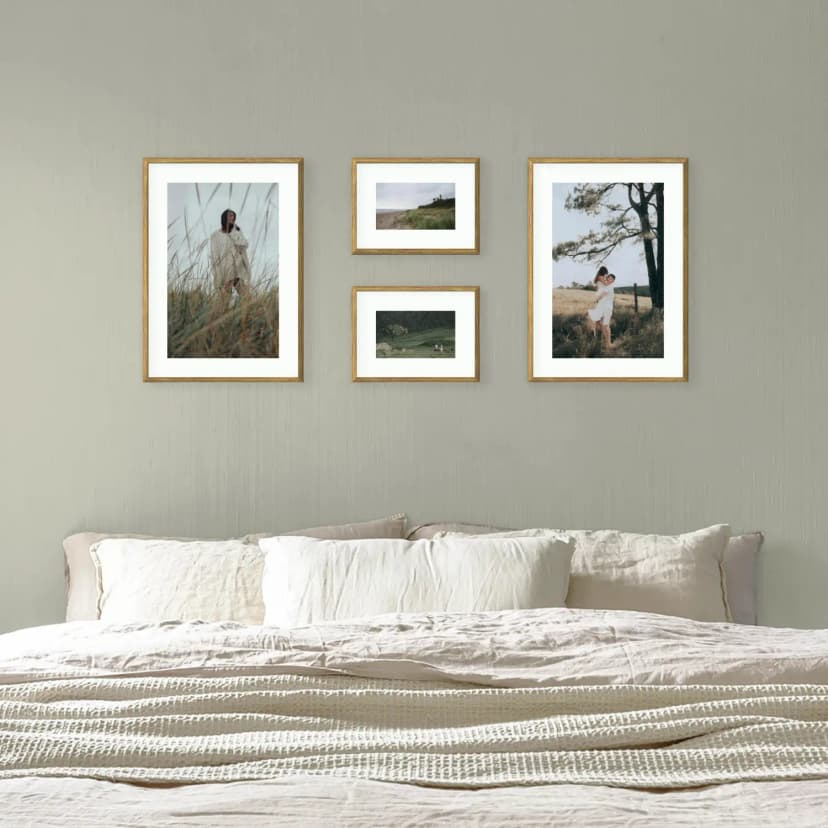
Under a sloped ceiling, hang the gallery on the low knee wall or the gable wall, not on the slope. Heights, layouts and fixings for attic rooms.
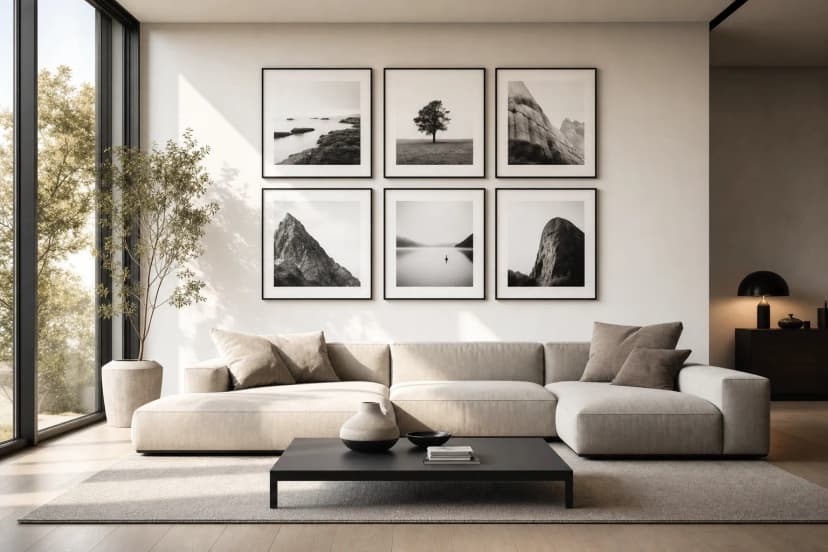
Treat the TV as one frame: centre the gallery on the screen, align edges, keep equal gaps and use larger frames near it. Four layouts that work.
Give it a try?
See how it works