Pet photo gallery: portraits, action shots, mixed with family, and 4 layouts that actually work for your wall.
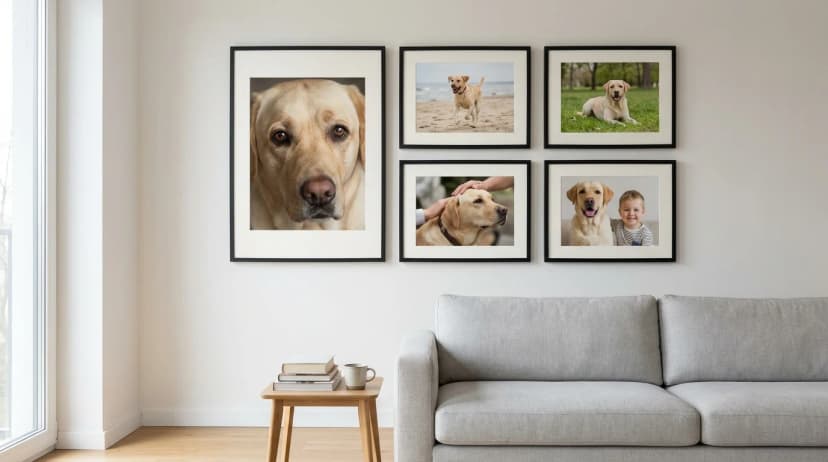
Quick answer: A pet photo gallery should have 4–7 frames mixing three shot types: portraits (40%), action shots (40%) and "human + pet" moments (20%). Choose frame sizes based on the pet's face or head size in the photo — a large dog portrait needs 30 × 40 cm or larger, cats work well in 20 × 30 cm. The best wall is where your pet spends most time — living room, entrance hallway, family room.
British households increasingly treat dogs, cats and rabbits as full family members — and a family photo gallery without the pet feels incomplete. Framky has shipped countless galleries where a poodle appears next to grandparents, and a ginger cat has its own frame above the desk. This article will show you how to plan such a gallery so it looks thoughtful, not just "stuck on like a sticker".
What makes a pet photo gallery different from a family gallery?
A pet photo gallery is a frame composition where at least 60% of shots feature the pet alone or with human family members. Unlike a purely family gallery, three unique selection criteria matter here: coat/fur quality (hard to capture during quick movement), personality (every dog and cat has "their expression" that family recognises), and frame proportions (pets in rooms often fill the entire frame, requiring a different approach than human portraits).
Three frame types worth having in your gallery
Type 1: Portrait (40% of gallery)
One pet, looking at camera or to the side, shot from 1–2 m distance. Ideally a quick shutter speed (1/500 s or faster) to keep eyes sharp.
What works best:
- Portrait from low angle (pet lying or sitting, you crouch to their height)
- Natural window light from the side (not from behind)
- Simple background — plain wall or natural setting (wood, grass)
Frame size: 30 × 40 cm for medium and large dogs, 20 × 30 cm for cats and small dogs.
Type 2: Action (40% of gallery)
Pet in motion — running, jumping, playing. Dynamic shots that show personality in a way a still portrait cannot.
What works best:
- Running on beach or park (fast shutter, 1/1000 s)
- Jumping for ball or stick
- Moment of play with another pet or person
Frame size: 30 × 40 cm or 40 × 50 cm (larger frame lets dynamic movement "breathe").
Type 3: Human + Pet (20% of gallery)
Photos showing relationship. Not a family portrait with the pet sitting beside you, but an interaction moment: someone petting, laughing with the dog, child reading with cat on lap.
What works best:
- Spontaneous moment (not posed)
- Touch or close physical contact (hand on back, face near fur)
- Both focused on something (not looking at camera)
Frame size: 40 × 50 cm or 40 × 60 cm.
Table: gallery proportions based on frame count
| Frame count | Portraits | Action | Human + pet | Frame sizes | Wall space |
|---|
| 4 | 2 | 1 | 1 | 30 × 40 cm | Small wall (< 150 cm) |
| 5 | 2 | 2 | 1 | 30 × 40 cm | 180 cm sofa |
| 6 | 3 | 2 | 1 | 30 × 40 cm | 200 cm sofa |
| 7 | 3 | 3 | 1 | 30 × 40 cm + 1 × 40×50 | 220 cm sofa |
Key principle: In a pet gallery, variety of shots matters more than quantity. Two portraits and two action shots make stronger impact than six similar selfies with the pet on the sofa.
Why low-angle or lap-level shots look better
Most dog and cat photos from phones are taken from eye level, looking down. This gives "snapshot photography" but lacks magic. An old rule of pet photography: shoot at the pet's eye level.
- For medium dog (Labrador, Border Collie) this means crouching or sitting on ground
- For small dog (Dachshund, Pug) — lying on your belly
- For cat — position from lap level or slightly lower
Effect: the pet becomes frame "hero", not background for your life. Photos shot at pet eye level are orders of magnitude better than "from above" versions.
Step by step: preparing a home photo session
- Choose the brightest room at home. Light is everything. Living room with large south or west windows works best between 10:00–16:00.
- Pick simple scenery. Avoid furniture with intense colours in background. Best: light wall, beige sofa, wood.
- Play with the pet for 10 minutes before session — tired cat and tired dog are more "relaxed in photos". Hyperactive pets won't sit still.
- Have treats or favourite toy handy — useful for directing pet's gaze toward you.
- Shoot lots of photos. 50–100 in one session is not excessive. Pets move fast, only 10–20% will be sharp.
- Select photos 1–2 days later — perspective helps separate "lovely" from "average".
How to mix pet photos with family photos
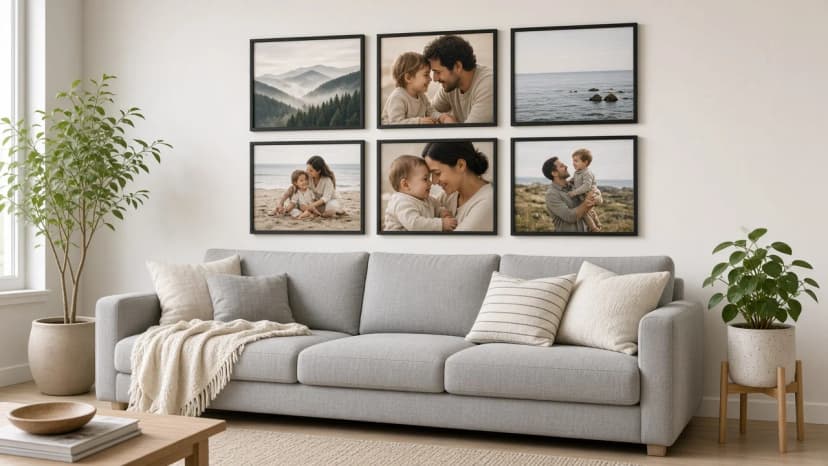
Most family galleries with dog or cat aren't "pet galleries" but "family galleries with a pet too". Two mixing strategies:
Strategy A: Dedicated section
Gallery of 9 frames: 6 family photos + 3 pet photos (2 portraits + 1 with family). Pet has "its section" in corner or bottom row.
Works when: pet is relatively new family member (< 2 years) or gallery is planned "family-first".
Strategy B: Equal standing
Gallery of 6–7 frames with equal representation: 3 family photos + 3 pet photos + 1 together. All as full-value shots, not "in a section".
Works when: pet is central part of daily life (with you many years, treated as family member).
How to capture your pet's personality
Every dog and cat has "their expression" — trait recognised only by household. The dog that "always tilts head listening". The cat that "squints one eye more". These small quirks are what make a gallery "our Gus" instead of "any Labrador".
Three approaches:
- Choose photos where family members smile involuntarily. If two people seeing the photo say "oh, that's what he looks like when he wants his walk" — perfect shot.
- Look for "ordinary" moments, not posed. Dog sleeping in odd position. Cat watching window. What you see daily but stopped noticing.
- Don't avoid "eyes closed" shots. Half-closed dog eyes, cat yawn, grimace — these show individuality.
When a pet gallery won't work
- When you don't have good enough photos. Four blurry phone shots from above won't become a good gallery. Better to wait for one solid session than force archive you don't have.
- In very minimalist interior. Pet galleries usually read as "emotional" and "personal". In ultra-minimalist style (e.g. Japanese zen) one portrait works, but gallery of 6 frames competes with interior aesthetics.
- When pet recently passed. Very individual. For some families "in memoriam" gallery is therapeutic. For others daily eye contact with deceased pet deepens grief. Trust your feelings, not what "should" be done.
FAQ — questions users ask
What dog photos look best in frames?
Portraits from low angle (at dog's eye level) with sharp eyes and natural light. Action shots — running, jumping, playing — work very well at 30 × 40 cm or 40 × 50 cm. Avoid photos taken from above, from iPhone in weak light, or with blurry background that obscures the dog.
Can I mix pet photos with family photos?
Yes, it's the most common choice. Two strategies: "dedicated section" (3 pet photos in corner of family gallery) or "equal standing" (pet as full family member, photos distributed in composition). Choice depends on how long you've had the pet and how important it is in daily family life.
How many dog or cat photos do I need?
For dedicated pet gallery — 4–7 frames. For family gallery with pet element — 2–3 pet photos in an 8–12 frame gallery. Below 4 is accent, not gallery. Above 7 becomes monotopic and may tire eye after months.
How to photograph a black dog or cat?
Black fur is the biggest technical challenge. Solutions: (1) lots of light — bright day at window or outside, never low light; (2) contrasting background — light wall, grass, beige sofa; (3) side light — isolates fur outline; (4) exposure +1/3 to +1 (most cameras underexpose black subjects). Never photograph black dog on black sofa.
Where to hang pet photo gallery?
Most common: living room — above sofa or main wall. Second: entrance hall (guests see pet right after entering). Third: hallway or foyer. Least typical but good: home office — your own pet photos have confirmed stress-reduction effect (see Gallery in home office).
Can cat portrait be in small frame?
Yes. Cats have proportionally larger heads relative to body than dogs, so close-up portrait fills frame even in small size. 20 × 30 cm is optimal for cat, 15 × 21 cm works as "mini-portrait" in series. For medium or large dog minimum is 30 × 40 cm, otherwise head in photo will be too small.
What next
If you're mixing pet gallery with family gallery, read How many photos in a gallery for proportions. For wall selection see Psychology of photo placement. If you're thinking pet photos in home office, check Gallery in home office — your own pet photos have documented stress-reduction effect.
Your pet photo gallery — printed with pigment inks for fur colour accuracy — you'll design in Framky configurator.