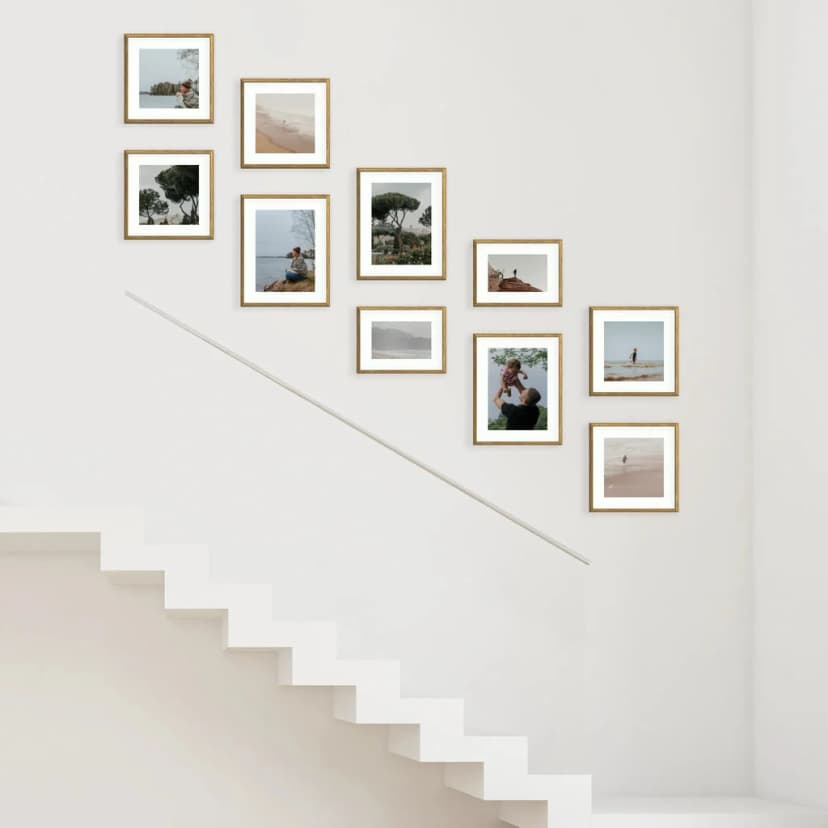
How to Hang a Photo Gallery Wall on Stairs
Hang a staircase photo gallery in about 15 minutes: measure the rise, pick a stepped layout, use Framky’s 1:1 template — no drill.
5 min read
Article
Photo gallery wall in a child's room 0–18 years — photograph selection, mounting height and safety for each developmental stage. Recommendations table.
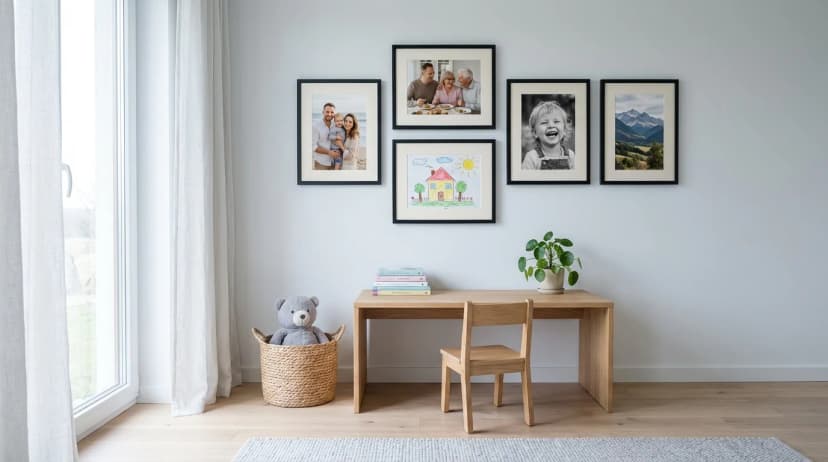
TL;DR: A photo gallery wall in a child's room should evolve as your child grows. For a newborn and toddler (0–3 years), hang frames high (centre at 160–170 cm) with soft family photographs. For a preschooler (4–6 years) — lower (140–150 cm) and add your child's own drawings. From school age onwards, your child co-decides the theme. Framky frames without glass eliminate cutting risk — a key safety advantage in a child's room.
A child's room isn't a space you design once for 18 years. Every 3–4 years developmental needs change, and what your child enjoys looking at and what inspires them shifts. A photo gallery wall in a child's room is one of the few decorations that can grow alongside your child — you swap individual photographs, but the composition's structure remains. This guide will show you how to build it across 5 life stages.
A photo gallery wall in a child's room is a composition of frames with photographs designed with three specific constraints in mind: physical safety (no sharp edges, no glass), changing viewing perspective (your child grows and views the gallery at different heights across stages), and emotional function supporting a sense of belonging. These three dimensions distinguish it from a living room gallery, where aesthetics is the only criterion.
Frames with glass pose risks in several scenarios typical of a child's room:
Framky frames are without glass — the protective role is played by a rigid cardboard plate under matte photographic paper. This eliminates cutting risk in 100% of falling scenarios.
Key principle: In a child's room, frame mounting has one job only: hold it safely. Framky's self-adhesive hangers support frames up to 50 × 70 cm weighing up to 900 g, well below their weight capacity — this increases the safety margin.
Mounting height is given as the centre of the composition's height from the floor. Frame count and type are recommendations for an average 8–14 m² room.
| Child's age | Centre height | Frame count | Theme | Child's involvement |
|---|---|---|---|---|
| 0–3 years (newborn, toddler) | 160–170 cm | 3–5 | Parents, grandparents, siblings, soft colours | None (parental choice) |
| 4–6 years (preschooler) | 140–150 cm | 4–6 | Family + favourite animals + 1–2 child's drawings | Minimal (choose 1 photo) |
| 7–10 years (primary school) | 130–140 cm | 5–8 | Child with friends, hobbies, travel, own photos | 50% co-decision |
| 11–13 years (secondary school) | 130–140 cm | 4–7 | Child's passions, heroes, teams, favourite places | Child decides, parents advise |
| 14–18 years (teenager) | 130–140 cm | 4–8 | Fully child-directed theme | Full child decision |
Goal: your child recognises the faces of closest family, builds a sense of belonging to the family.
What to hang:
Height: centre at 160–170 cm. A child aged 0–3 views from below — a gallery at an adult's eye level is simultaneously out of reach for small hands and within the field of view of a parent holding the child.
Safety: frames must be well away from the cot (minimum 50 cm to sides and 30 cm vertically). A child standing in a cot can reach further than you'd expect.
Goal: your child starts identifying with their own room, recognises themselves in childhood photographs.
What to hang:
Height: centre moves to 140–150 cm. A 4–6 year-old is 100–115 cm tall, so a gallery at 140 cm sits at their eye level.
Involvement: ask your child which photograph they'd like in their room. Most preschoolers choose something family-related or involving an animal — a first curatorial exercise.
Goal: your child builds their own identity around interests — sport, books, friends.
What to hang:
Height: 130–140 cm. A 7–10 year-old is 120–140 cm tall — the gallery is literally at their eye level.
Involvement: your child co-decides 50%. Show them 8–10 candidates, let them pick 5.
Goal: your child separates from your imposed style, seeks out their own heroes and passions.
What to hang:
Involvement: your child decides, you advise on proportion and photograph quality. Boundary: you don't approve of controversial or age-inappropriate material, but otherwise you step back.
Goal: a teenager's room is a statement of identity. The photo gallery is part of that statement.
What to hang:
Closest family: 2–3 photographs of parents and grandparents in natural light, ideally portraits or half-portraits. Add 1–2 photographs of siblings or a pet, if applicable. Newborns learn to recognise faces through repeated exposure — a gallery in the room is a form of daily, incidental learning.
The gallery centre should be at 140–150 cm from the floor. A 4–6 year-old typically stands 100–115 cm tall, so a gallery at 140 cm sits precisely at their eye level. This is the first height where a child can look at their photographs independently.
Yes — they're among the safest frame types for a child's room. No glass eliminates cutting risk if the frame is knocked or dropped. Additionally, Framky frames are light (up to 900 g for 50 × 70 cm) and MDF profiles have rounded edges — if accidentally struck, injury risk is minimal.
Yes — it's an excellent idea. Show your child that their drawing is "artwork" worthy of a frame. Choose a drawing on A4 or A3 paper and a 30 × 40 cm or 40 × 50 cm frame. Off-white mounting around the drawing adds museum-quality prestige. Swapping the drawing every 6–12 months in the same frame is also a lovely ritual.
We recommend swapping 1–2 photographs every 12 months (e.g. on a birthday), and a complete gallery "refresh" every 3–4 years as your child enters a new developmental stage. Changing one photograph in a Framky frame takes about 90 seconds on average (based on Framky internal testing) — it's not a project, it's a ritual.
For 0–3 years — no. Keep the gallery high (160–170 cm), the child views it from a parent's arms. From age 4 onwards — yes, lower to 140–150 cm and below so the child makes independent eye contact with the photographs. After age 7, the gallery sits at 130–140 cm and stays there for the following years.
Once you've chosen photographs and set the height, it's worth thinking about their arrangement — Psychology of photo placement will help. If you want to understand the psychological impact of a family photo gallery on your child, read Psychology of photographs on walls and wellbeing. For planning frame count for available wall width, check How many photographs in a wall gallery.
Design a gallery tailored to your child's room — with safe MDF frames without glass and self-adhesive hangers — in Framky's configurator.
Sign up and we'll send you a code with a bigger discount than the shop offers — plus occasional inspiration for your photo gallery wall.
Hang a staircase photo gallery in about 15 minutes: measure the rise, pick a stepped layout, use Framky’s 1:1 template — no drill.
Hang a photo wall in the stairwell: measure the rise, pick a layout along the banister, use a 1:1 template. No drill, about 15 minutes.
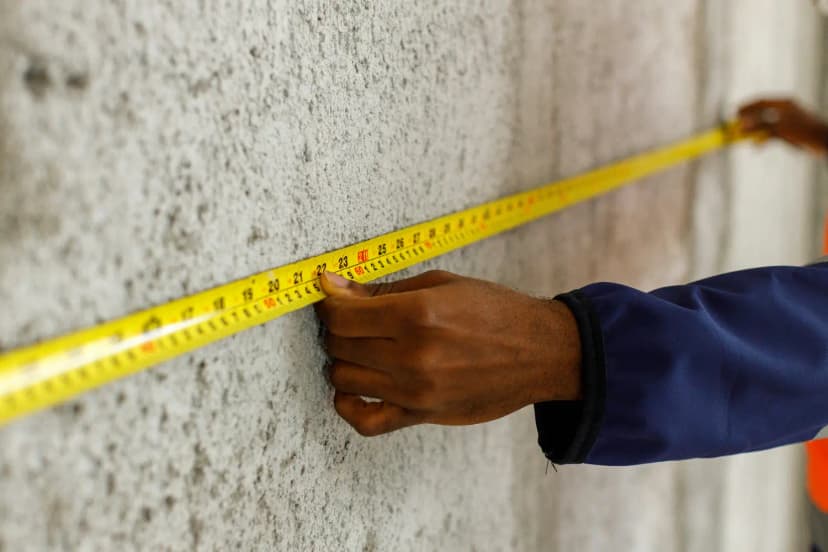
See gallery wall layouts with real sizes — 3, 5, 6, 8, 10+ frames. Match a Framky kit to your wall width, then hang with a 1:1 template.
Give it a try?
See how it works