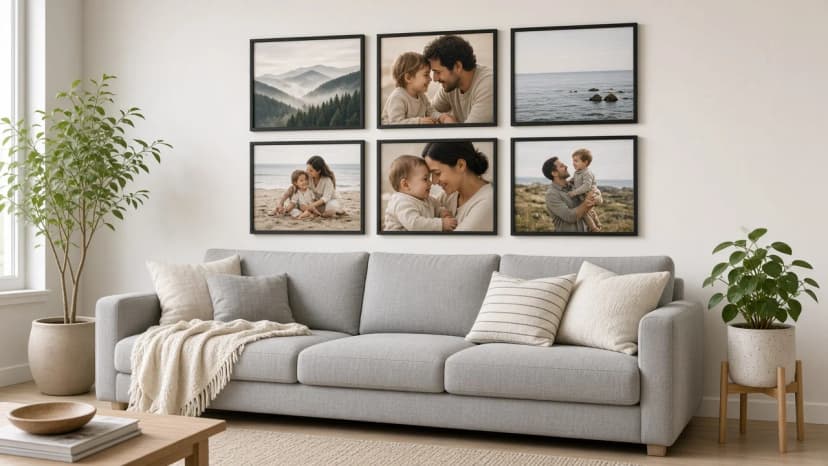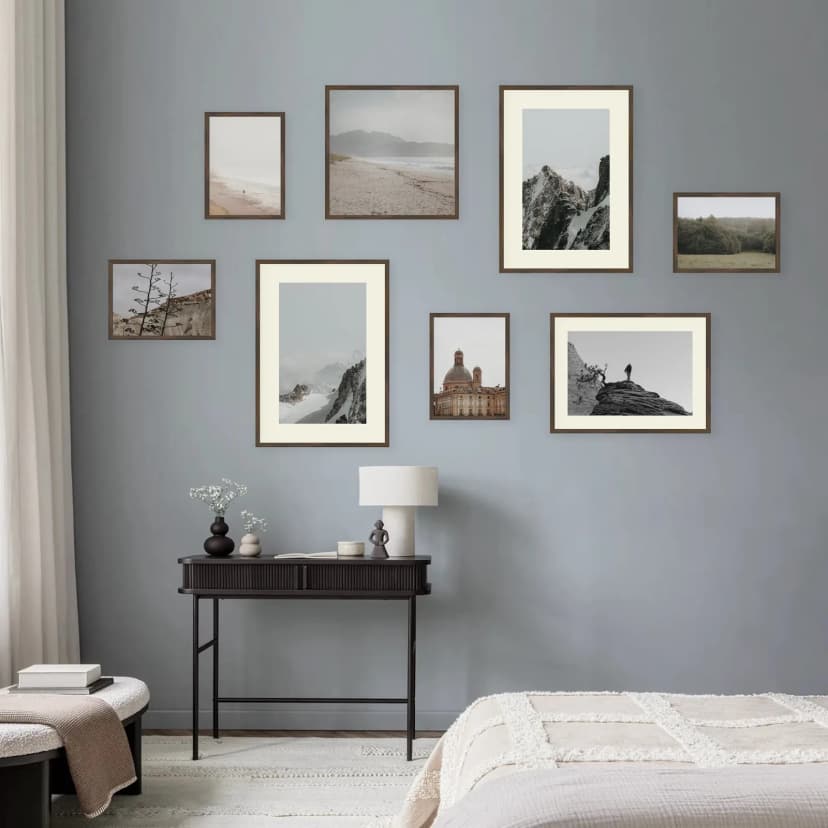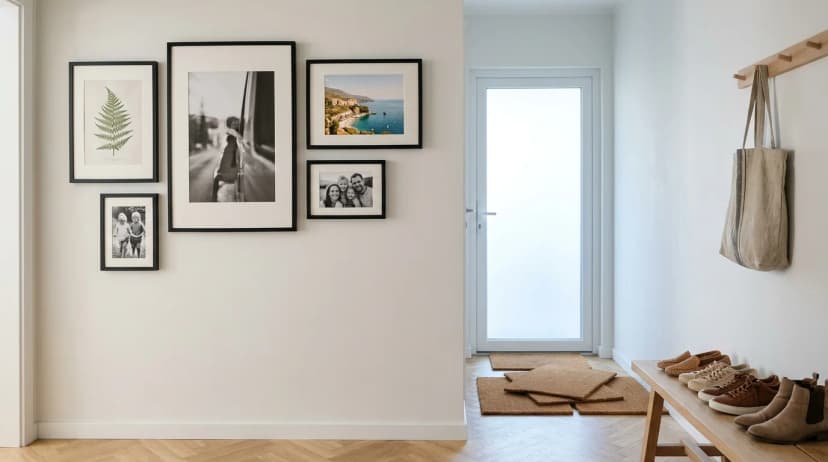
TL;DR: A gallery in your entryway should occupy 50–65% of the available wall length, and the centre of the composition should be positioned at 145–155 cm from the floor. On a typical UK entryway wall of 2–3 m, you can comfortably fit 3–7 Framky frames in a linear layout — without drilling, using self-adhesive hangers.
Your entryway is the first interior your guests see — and the last space you leave when stepping out of your home. In UK properties, it typically measures 1.5–4 m in length and 1.2–2 m in width, meaning every design decision matters more here than in a living room. A well-planned photo gallery wall transforms this transitory space into a personal statement about your home. A poorly planned one makes the entryway feel cramped and chaotic.
What is a photo gallery wall in an entryway?
A photo gallery wall in an entryway is a composition of 3–9 frames hung on one wall in the entrance zone, designed for limited viewing depth (1–2 m distance from the wall) and brief eye contact (typically 4–6 seconds whilst entering or leaving). Unlike a living room gallery, its purpose isn't to encourage prolonged contemplation, but to create a cohesive, memorable first impression.
Why entryways require a different approach than living rooms
Entryways are governed by three limitations that don't exist simultaneously in other rooms:
- Narrow viewing angle — looking at a 50 cm-wide photograph from 1 m away, you see it at over 26° angle. Too wide to take in the entire composition in one glance.
- Brief exposure time — guests view the gallery in passing, not approaching closely. Detail loses to rhythm.
- Competition with function — coat pegs, mirror, shoe storage. The gallery must coexist, not fight for space.
For these three reasons, linear, monochromatic and distinctly rhythmic compositions work best in entryways — anything that helps the brain understand the image in a fraction of a second.
How many frames fit in a typical UK entryway?
The table below shows how many Framky frames will comfortably fit on a wall of various lengths, assuming 5–7 cm gaps between frames and 15–20 cm margins from doors and corners.
| Wall length | Max frame size | Minimum frames | Recommended number | Maximum (without overwhelming) |
|---|
| 1.0 m | 20 × 30 cm | 2 | 3 | 4 |
| 1.5 m | 30 × 40 cm | 3 | 4 | 5 |
| 2.0 m | 30 × 40 cm | 3 | 5 | 7 |
| 2.5 m | 40 × 50 cm | 4 | 6 | 8 |
| 3.0 m | 40 × 60 cm | 4 | 7 | 9 |
| 4.0 m | 50 × 70 cm | 5 | 9 | 12 |
Key principle: A gallery in your entryway should occupy 50–65% of the wall length it occupies. Less feels haphazard; more becomes overwhelming and visually narrows the corridor.
How high to hang the gallery in an entryway?
In most entryways, the centre of your composition should be positioned at 145–155 cm from the floor. This is the museum standard, which works well for most adult guests in UK properties.
Two situations where it's worth deviating:
- If there's a coat peg above the gallery — position the gallery below 140 cm and leave at least 15 cm clearance above the highest hung coat. Otherwise, sleeves will obscure the bottom row of photographs.
- If there's a bench for putting on shoes opposite the gallery — lower the centre to 130–135 cm. Someone sitting views from a perspective 20–25 cm lower than standing, and the gallery should be legible for them too.
Three layouts that work in narrow entryways
Layout 1: Single-line arrangement
The safest choice for entryways 1–2 m wide. Frames of the same size (e.g. 6 × 30 × 40 cm) in one row, aligned to a common horizontal axis. 5–6 cm spacing. Effect: order, elegance, visual illusion of corridor length.
Layout 2: Line with central accent
One larger frame (40 × 60 cm or 50 × 70 cm) in the centre, with 2 smaller frames (20 × 30 cm or 30 × 40 cm) on each side. The central point draws the eye, the sides create rhythm. Excellent choice when you have one "most important" photograph (wedding, family portrait) you want to highlight.
Layout 3: Two-row rhythm
Only for entryways wider than 2 m or walls longer than 3 m. Two rows of frames at the same height, 6–8 cm spacing between rows. Caveat: this layout visually "lowers" the ceiling, so avoid it in properties with ceilings below 2.5 m.
Step-by-step: how to plan a gallery in 6 steps
- Measure the wall — length (cm), ceiling height, skirting board height, position of switches and sockets. Write everything down.
- Choose photographs — 6–10 frames with cohesive tone (black and white, sepia, single colour palette). Mix of portraits and landscapes works better than portraits alone.
- Decide on layout — linear, with central accent, or two-row. Use the table above to match frame count to wall length.
- Prepare paper templates — cut grey paper rectangles to exact dimensions of your chosen frames. Tape them to the wall with painter's tape and adjust spacing.
- Live with it for 48 hours — leave templates up for two days. Check whether they obstruct movement, block door opening, and whether the layout "works" in natural morning light.
- Install frames — using self-adhesive hangers, following the manufacturer's instructions exactly. Wall must be dry, degreased, and between 15–25 °C.
Why self-adhesive hangers are the best choice in an entryway
Entryways have the most walls where you don't want to drill: joints with stairwells (noise), partition walls of plasterboard, wallpaper, old plaster masonry. In each of these cases, Framky's self-adhesive hangers support frame weight up to 50 × 70 cm and 900 g mass.
Self-adhesive hangers won't damage walls, provided the paint is firmly bonded to plaster and the plaster itself is stable. Before installing, test on a hidden wall area (e.g. behind a coat peg): stick one hanger for 24 hours, then remove it following instructions. If paint comes off with the tape — don't proceed.
For a detailed guide to drilling-free installation, see Hanging frames without drilling.
Most common mistakes to avoid
- Gallery too high — centrepoint above 160 cm escapes natural field of vision. The most common mistake in UK entryways.
- Frames too small — 13 × 18 cm or 15 × 21 cm disappear in an entryway. Sensible minimum is 20 × 30 cm, realistically 30 × 40 cm.
- Gallery on both opposite walls — creates a "mirror tunnel" effect that visually narrows the corridor. Choose one wall and leave the other empty or with a mirror.
- Large wood-effect frames in a small entryway — thick 4–5 cm profiles eat up space visually. In entryways up to 2 m, choose MDF profiles up to 2.5 cm wide.
When a gallery in an entryway won't work
This guide doesn't apply to three situations:
- Entryway with no wall longer than 90 cm — in very small vestibules (studio flats) a single large photograph works better than attempting to fit a gallery.
- Entryway with strong side light from a window — if the wall opposite your gallery has a window, reflections will interfere with viewing. Framky frames are without glass so they don't produce reflections themselves, but adjacent glazed elements (mirror, cabinet) will.
- Humidity > 60% RH — in older properties with rising damp, photographs on matte photographic paper lose durability. Fix the damp first, hang the gallery later.
FAQ — questions our users ask
How high should I hang photographs in an entryway?
Your composition's centre should be at 145–155 cm from the floor. If you plan a coat peg below the gallery, leave at least 15 cm clearance between the highest hung coat and the bottom edge of the lowest frame.
How many frames fit in a narrow corridor?
On a 2 m wall, you can comfortably fit 3–7 frames, assuming they occupy 50–65% of the wall length. Recommended frame size for such a wall is 30 × 40 cm. Detailed sizing relationships are shown in the dimensions table above.
Should an entryway gallery have a theme?
Yes. In an entryway where the eye lingers for 4–6 seconds, cohesion works more powerfully than variety. Choose one theme (family, travel, black-and-white portraits) or one colour tone. Mixed themes only work from 4–5 metres of wall length onwards.
Can I hang a gallery in a rented flat?
Yes. Framky's self-adhesive hangers are designed precisely for walls where drilling is forbidden. Before installing, test on a hidden wall area: stick one hanger for 24 hours and check whether paint comes off when you remove the tape.
What frame size for a small entryway?
For an entryway 1–1.5 m wide, optimal sizes are 20 × 30 cm and 30 × 40 cm. Larger frames (40 × 60 cm, 50 × 70 cm) need at least 1.5 m viewing distance to be properly absorbed visually — in a tight entryway they'll look cramped.
Do Framky frames reflect in light?
No. Framky frames are without glass — the protective role is played by a rigid cardboard plate under matte photographic paper. No glass means no reflections, which is especially important in entryways lit by side light from a window or wall lights above entrance doors.
What's next
If you're planning a gallery not just in your entryway but also along a corridor to other rooms, check out Photo gallery in a corridor — corridor ideas. Once you've chosen your wall, it's also worth reading Psychology of photo placement, which explains why some walls in your home work better for galleries than others. For a complete 8-step planning process for galleries in any space, see How to plan a photo gallery wall.
You can design a finished gallery for your entryway in Framky's configurator — choose frame count, sizes and layout, and we'll handle printing on matte photographic paper and dispatch with self-adhesive hangers included.