Quick answer: Five trends we see in gallery walls across British homes in 2026: (1) return to minimalism — fewer frames, larger formats, (2) black and white family portraits, (3) monochromatic compositions from a single subject, (4) mixing photographs with artwork in two formats, (5) seasonal galleries swapped twice yearly. Three trends we consider short-lived: saturated palettes from "Instagram 2022", mini-portrait grids of 12 small frames, and AI-generated imagery galleries. Trends are conversation fuel, but your gallery lives with you for 10+ years — choose photographs, not style.
Most articles on interior design trends are written in a tone of "this is fashionable now, so you must have it". This article goes against the grain: we present 5 trends we see in British gallery walls in 2026, but for each we honestly assess whether it has a chance of lasting 3 years or will become a visual trap. The goal: help you choose only those elements that truly fit your life — not your Pinterest feed.
What Are Gallery Wall Trends?
Gallery wall trends are recurring aesthetic patterns visible in new gallery orders, interior publications, and social media in a given year. Unlike "interior style" (which changes every 5–10 years), gallery trends are faster — they appear and disappear in a 1–3 year cycle. Some become a lasting part of classic design, others quickly date the interiors where they are applied.
Three Criteria for Assessing a Gallery Trend
Before we examine the five 2026 trends, it is worth establishing how we assess them:
- Longevity — will the trend still look current after 3 years, or will it age like wooden frames from the 1980s?
- Cost of Change — how much does it cost you to exit the trend if fashion shifts? A gallery with interchangeable frames is low cost. A gallery with painted frames is high cost.
- Compatibility with Classics — does the trend add to classic principles, or break them? Trends that complement classics survive. Trends that break them do not.
Table: 5 Trends 2026 with Assessment
| Trend | Description | Longevity | For Which Interior | Rating |
|---|
| Minimalism "Less but Larger" | 3–4 large frames instead of a 9-frame gallery | High | Contemporary, Scandinavian, Japandi | Worth investing |
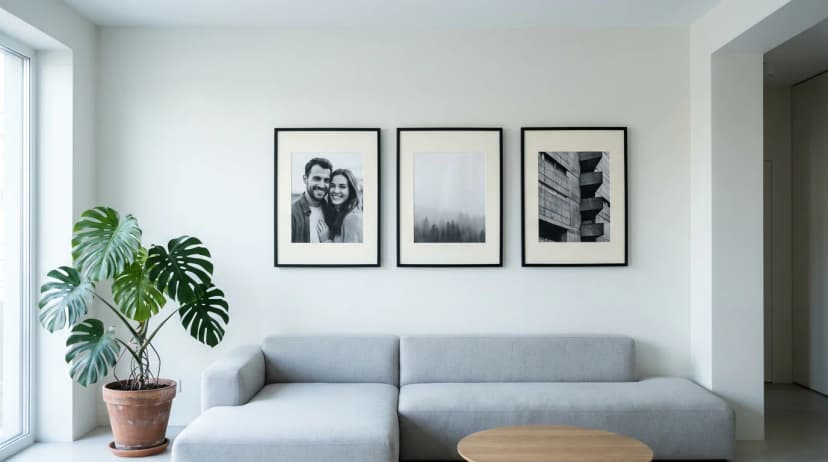
| Black and White Family Portraits | Galleries exclusively in B&W, focused on faces | Very High | Any interior | Timeless |
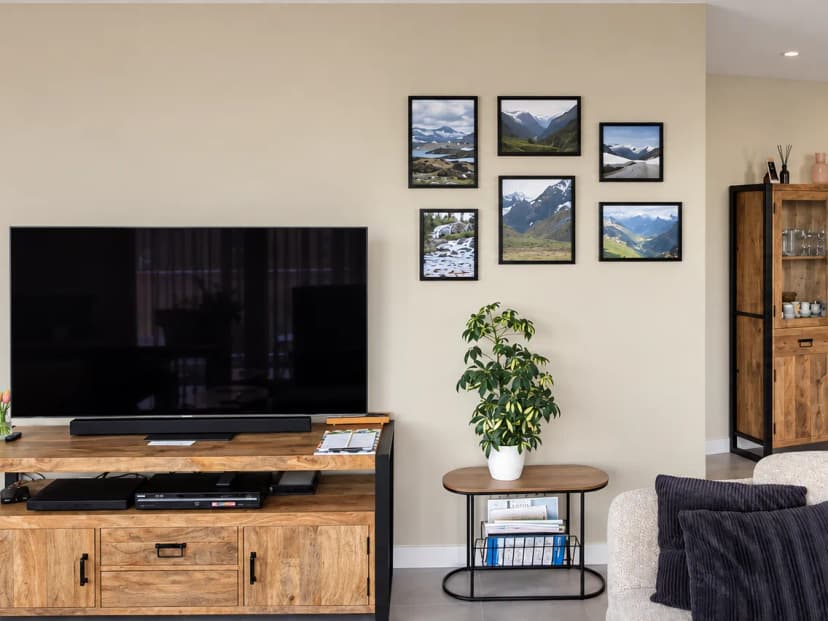
| Monochromatic Subject Matter | Entire gallery from one theme (mountains, sea, forest) | High | Minimalist, Industrial | Stable choice |
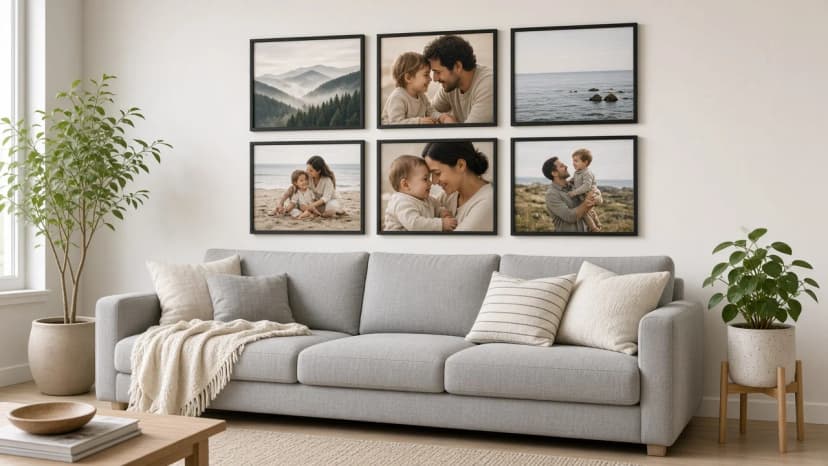
| Mixing Photographs with Artwork | Gallery of photos + 1–2 illustrations or graphics | Medium | Creative, Artistic | Works with restraint |
| Seasonal Swaps | Photo rotation twice yearly | Growing | Any interior | Growing fast |
Key principle: Trends are conversation fuel, but your gallery lives with you for 10+ years — choose photographs, not style. The only trend worth serious consideration is one that strengthens your emotional connection to the frames, not "how it looks to others".
Trend 1: Return to Minimalism "Less but Larger"
What it is: Instead of a 9-frame gallery in a 3 × 3 grid, the new trend is a 3–4 frame gallery in large format (50 × 70 cm or 60 × 90 cm). Each frame has room to "breathe".
Why this is a 2026 trend: It is a reaction to oversaturation with "Instagram-style" collage galleries over the past 5 years. British interior designers in 2024–2025 are returning to classical, single focal points on walls.
For which interior: Minimalist, Scandinavian, Japandi, contemporary loft. Works less well in richly furnished interiors.
Advantages:
- Timeless — fewer frames mean lower risk of "dating" the gallery
- Easier to plan (fewer compositional decisions)
- Demands better photograph quality (an advantage — forces selection)
Disadvantages:
- Higher initial cost per frame (large formats are pricier)
- Less narrative — 3 photographs won''t tell a story as well as 9
Longevity rating: Very high. Minimalism is not new; it returns in cycles.
Trend 2: Black and White Family Portraits
What it is: Galleries consisting exclusively of black and white portraits of family members — often professionally shot, sometimes converted from colour photographs with a retro look.
Why this is a 2026 trend: A return to "classical family photography" in contrast to the saturated, filtered photographs of recent years. Black and white looks "timeless" and does not age with colour trends.
For which interior: Any interior. Black and white portraits suit classical, contemporary, industrial and rustic settings — they are universal.
Advantages:
- Genuinely timeless — a gallery of B&W portraits from 1960 and 2026 looks similar
- Eliminates colour consistency concerns (see Colour Harmony in Galleries)
- Emotionally powerful — black and white emphasises facial expression
Disadvantages:
- Requires good portrait photographs (some photographs work better in colour)
- May look "sad" or "heavy" in cheerful families with young children
Longevity rating: Very high. If choosing one trend only — choose this one.
Trend 3: Monochromatic Subject Matter
What it is: A gallery where all photographs come from a single theme — e.g. exclusively mountains, exclusively sea, exclusively forest, exclusively urban architecture. Different frames, same "thematic family".
Why this is a 2026 trend: It represents a reaction to family galleries of "a bit of everything". Thematic galleries are easier to compose and give the impression of a professional "project", not random compilation.
For which interior: Minimalist, industrial, contemporary. Works less well in traditional British interiors with many furnishings and decorations.
Advantages:
- Natural colour consistency (mountains have their own tones, the sea its own)
- Ease of selection — you choose from one "basket" of photographs
- The gallery tells one story, not five
Disadvantages:
- Requires access to many good photographs from a single subject (for a "mountain gallery" you need 6–9 good mountain frames — you may not have them)
- Absence of family photographs — the gallery becomes "landscape", less personal
Longevity rating: High. Thematic galleries were a classic for decades; they are now returning with a new name.
Trend 4: Mixing Photographs with Artwork and Graphics
What it is: Galleries where 70–80% of frames are photographs, but 20–30% are graphics, posters, drawings. Everything in one convention (e.g. all in frames of the same colour and size).
Why this is a 2026 trend: British interiors from 2020–2024 were heavily dominated by "photo-only galleries". The new wave is a return to "mixed" galleries known from classical homes of the 1970s–80s.
For which interior: Creative, artistic, loft spaces. Families involved in design, graphics, illustration.
Advantages:
- Greater visual variety
- Allows artistic accents (poster of a favourite film, gallery artwork)
- Photographs "gain" in the company of graphics
Disadvantages:
- Risk of chaos — if photograph and artwork styles do not complement each other, the gallery "falls apart"
- Requires purchasing separate illustrations (additional cost)
- Harder to plan — more variables
Longevity rating: Medium. Works in specific interiors, ages quickly in others. We recommend with caution.
Trend 5: Seasonal Galleries Swapped Twice Yearly
What it is: A gallery designed with the idea of swapping photographs twice a year (summer and winter sets). Swaps happen without removing frames — photographs are inserted from the back into the same frame.
Why this is a 2026 trend: Awareness that our interior "lives" with us, not frozen in time. Seasonal swaps allow greater dynamism without the cost of drilling new holes.
For which interior: Any interior where the gallery is a central feature of the living room or bedroom.
Advantages:
- The interior "breathes" with the seasons
- Full compatibility with self-adhesive hangers (no drilling, easy swaps)
- Double printing cost, but one-time frame cost
Disadvantages:
- Requires a larger photograph archive (2 sets)
- Additional effort twice yearly
- Does not suit "timeline" galleries (e.g. a child''s first year) — those are permanent
Longevity rating: Growing. This is a trend that will be stronger in 2027 than 2026. See in detail Seasonal Photo Rotation in Galleries.
Three Trends Not Worth Investing In
Trend Not Worth It 1: Saturated "Instagram 2022" Palettes
What it is: Heavily filtered photographs with high saturation, "Orange & Teal" colour grading, dramatic contrasts.
Why not: In 3 years you will look at your gallery and see the date the photographs were taken, not the emotions. Like sepia in the 1990s.
Better alternative: Natural palette, muted saturation, subtle editing.
Trend Not Worth It 2: Galleries of 12 Mini-Portrait Frames in a Grid
What it is: A grid of 12 small frames (20 × 30 cm), each with a single portrait, all on one wall.
Why not: This looks like a "collage" or "motivational poster", not a gallery. It requires a surprisingly large number of photographs that quickly become visually exhausted.
Better alternative: 6 larger frames (30 × 40 cm) instead of 12 small ones.
Trend Not Worth It 3: Galleries with AI-Generated Images
What it is: Frames with images generated by AI tools (Midjourney, Stable Diffusion, DALL-E).
Why not: (1) AI images are quickly recognisable as "AI art" by rendering style and rapidly date a gallery; (2) they lack emotional connection — this is not your memory; (3) the AI art ecosystem changes so rapidly that an image from 2024 already looks "old" in 2026.
Better alternative: Real photographs from your life or works by local artists (graphics, illustration).
FAQ — Questions Users Ask
What Gallery Style for 2026?
Minimalism "less but larger" (3–4 large frames instead of a 9-frame grid) and black and white galleries are the two most stable directions for 2026. Monochromatic subject galleries (entire gallery from one theme) and seasonal swaps are growing trends. Avoid "Instagram-style" galleries with saturated photographs and 12-frame small portrait grids — these age quickly.
What Is Passé in Gallery Walls?
Three things: (1) saturated palettes with "orange & teal" filters popular in 2020–2023, (2) galleries of 12+ frames in small sizes (20 × 30 cm), (3) AI-generated images. The first two were fashionable but age with the decade. The third is "new" but emotionally incoherent and changes too fast to be a lasting investment.
Should I Follow Interior Trends on Pinterest?
Only when a trend complements classical principles rather than breaks them. The "minimalism" trend is essentially a return to basics — worth it. The "15-small-frame collage" trend breaks composition rules — not worth it. Use Pinterest for inspiration, but assess each trend against longevity, cost of change, and compatibility with classics.
Can I Combine Trends?
Yes, some complement each other. Example: a gallery of 4 large black and white family portraits (trend 1 + trend 2). This gives a timeless, minimalist effect amplified by the power of B&W photography. Another example: a monochromatic mountain gallery swapped seasonally (trend 3 + trend 5). Avoid combining conflicting trends — e.g. "mixing photos with artwork" and "minimalism" rarely work together.
Which Trend Is Best for a Small Flat?
Minimalism "less but larger" (trend 1) — perfect for small flats where a 9-frame gallery doesn''t fit proportionally anyway. 3 large frames (40 × 50 cm or 40 × 60 cm) above the sofa have more impact than 9 small ones. Details in Gallery Wall in a Small Flat Up to 40 m².
Should I Wait for a Better Trend?
No. A photo gallery is not "seasonal fashion" — family photographs, portraits, favourite landscapes never go out of use. All that changes are details (frame size, B&W vs. colour ratio, frame style). If you have photographs you want on the wall, build your gallery now. You cannot catch up with trends — and you should not try.
What Next
If you want to plan a gallery following the "less but larger" trend, start with How Many Photos in a Gallery Wall — helps you select the right numbers and dimensions. For colour harmony, see Colour Harmony in Galleries. If seasonal swaps interest you, Seasonal Photo Rotation in Galleries covers it in detail.
You can design a gallery in timeless, classic style — with MDF frames without glass that do not age with trends — in the Framky configurator.