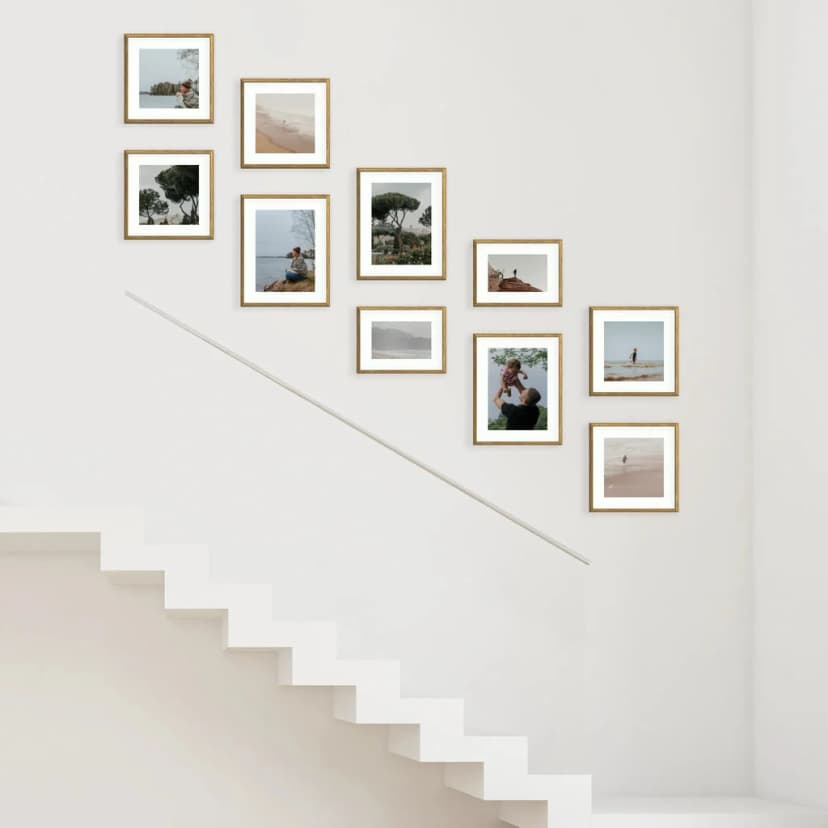
How to Hang a Photo Gallery Wall on Stairs
Hang a staircase photo gallery in about 15 minutes: measure the rise, pick a stepped layout, use Framky’s 1:1 template — no drill.
5 min read
Article
How to plan a photo gallery wall in a studio flat or 1-bed flat up to 40 m² — number of frames, sizes, priority wall and 3 mistakes that visually shrink small flats.
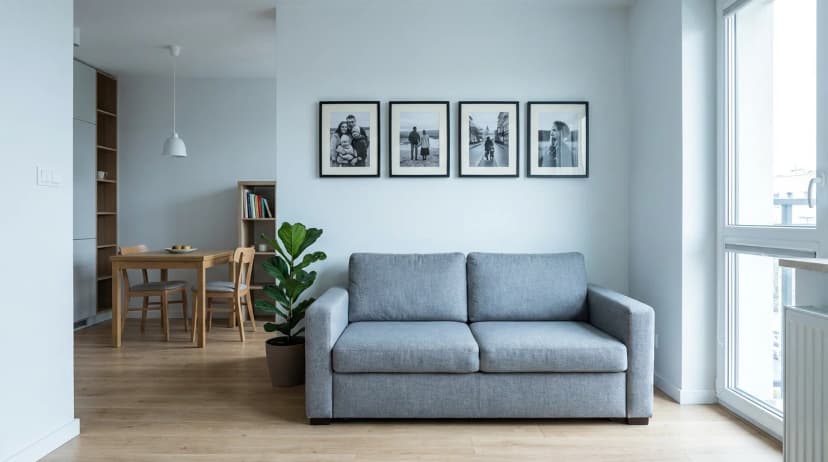
Short answer: In a flat up to 40 m² a photo gallery wall should have 3–5 frames, concentrated on one priority wall — most often above a sofa or desk in the lounge area. The optimal size of a single frame is 30 × 40 cm; larger sizes (40 × 60 cm and 50 × 70 cm) overwhelm the proportions of rooms below 40 m². Key mistakes: gallery on two opposite walls (creates a cramped effect), frames too small (< 20 × 30 cm disappear), frames too large (dominate and "eat" space).
UK flats (studio, 1-bed and 2-bed up to 50 m²) present their own design challenge category. Rules that work in a 70 m² flat become opposites in a 28 m² studio. A photo gallery wall that gives character to a large lounge can paradoxically "shrink" a small flat if poorly planned. This article shows how to use a gallery to make a small flat feel welcoming — not visually overwhelming.
A gallery in a small flat (< 40 m²) is a composition of 3–5 frames designed with three additional constraints: proportionality to small furniture, economical use of "visual breathing room" (limited empty wall space), and a more intense psychological effect, since walls are present in your view from everywhere in the flat. Unlike large flats, where a gallery is one of many accents, in a studio flat it''s often one of just two or three decorative elements — which means it cannot afford to be poorly planned.
| Flat Size | UK Type | Recommended Number of Frames | Max Frame Size | Min Frame Size | Optimal Wall |
|---|---|---|---|---|---|
| 18–25 m² | Studio | 2–4 | 40 × 50 cm | 30 × 40 cm | One — above bed or sofa |
| 26–32 m² | 1-bed small | 3–5 | 40 × 60 cm | 30 × 40 cm | One — above sofa |
| 33–40 m² | 1-bed large, 2-bed small | 4–6 | 50 × 70 cm | 20 × 30 cm | One — above sofa or in hallway |
| 41–50 m² | 2-bed | 5–7 | 50 × 70 cm | 20 × 30 cm | 1–2 walls |
Key principle: In a flat < 40 m² use one wall for a gallery. Two walls with frames in small space creates a "tunnel" effect — your eye loses its point of reference and the flat feels more cramped than it actually is.
Rule: the gallery goes on the wall that''s the first thing you see when entering the flat. For most UK studio and 1-bed flats, there are three scenarios:
The priority wall is the one where your eye naturally lands when you come in from the hallway. Usually this is the wall behind a sofa or behind a bed. A gallery of 3–4 frames there is enough to define the character of the entire flat.
Gallery always in the lounge, above the sofa. The bedroom in a 1-bed is usually so small (6–9 m²) that an additional gallery eats up psychological space. Instead, hang 1 anchor frame 40 × 60 cm above the bed.
At this size you can afford a gallery in the lounge + a single accent in the hallway or entrance. Never in the bedroom and lounge simultaneously — that''s visual overload.
In a large lounge (> 25 m²) a 50 × 70 cm frame looks proportional. In a studio of 22 m², where a sofa is 180 cm wide, the same 50 × 70 cm frame takes up 40% of the sofa''s width and visually "sits on top" of it. Your brain then doesn''t see "a frame as an accent" — it sees "a wall with a prominent block".
Three practical observations from UK small flats:
Tunnel effect in a small flat happens when two opposite walls have active visual elements — for example, a gallery on one and a TV + shelving on the other. Your eye has nowhere to "rest" because every direction shows density. Your brain interprets this as cramped.
Three ways to avoid this mistake:
9–12 frames of 20 × 30 cm on a 200 cm wall becomes "a poster wall", which doesn''t work in a small flat. Your brain registers chaos and interprets it as "clutter", which is a psychological equivalent of crampedness. Stick to 3–5 larger frames.
A gallery needs 15–20 cm of "breathing room" on the sides. If you squeeze 5 frames into the space between a door and window frame, even the best photographs will look "random" and increase the feeling of crampedness.
In a large lounge you can afford a mix of black and oak frames. In a studio flat that''s an instant signal of visual chaos. Pick one frame colour (best matte black or white) and stick with it.
Paradoxically, a well-designed gallery can make a flat feel larger:
It depends on execution. A poorly planned gallery (too large, on two opposite walls, chaotic mix of frame styles) can paradoxically shrink visual space. A well-planned one (3–5 frames, consistent style, one wall, proportional sizes) can actually enlarge a flat visually through the eye-leading effect.
For a studio of 18–25 m² we recommend 2–4 frames. Below 2 it''s not really a gallery anymore, just an accent; above 4 it starts competing with other elements of the flat. The optimal size is 30 × 40 cm, maximum 40 × 50 cm as a single "anchor".
Best above the sofa in the lounge area. For a 1-bed of this size, 4–5 frames of 30 × 40 cm in an asymmetrical layout will take up 50–65% of a typical sofa''s width (180–200 cm). Avoid hanging simultaneously in the bedroom — a 1-bed can''t sustain two galleries.
Yes, if the bed is on the priority wall (the first one you see when entering). We recommend 2–3 frames in a horizontal layout, centred at 140–150 cm from the floor. Note: in a studio where the bed serves as a "sofa" during the day, a gallery above it is visible from the entire flat and becomes a dominant element.
Optimally 30 × 40 cm as standard and one 40 × 50 cm as an "anchor" to the composition. 50 × 70 cm in a 25 m² lounge already dominates the room''s proportions. If you want one large frame instead of a gallery, 40 × 60 cm is a good compromise.
Very much — Scandinavian style is built on clean walls with a few clear accents. A gallery of 3–4 matte black MDF frames with black and white photographs (family, landscape) fits this aesthetic perfectly. Avoid mixing frame colours and overly saturated photographs — they don''t match the Scandinavian palette.
For exact proportions and frame numbers see How many photographs in a gallery wall. If you have mixed frame sizes, How to align frames of different sizes on a wall will help. If you''re renting a small flat and worry about your deposit, check out Photo gallery wall in a rented flat.
You''ll design a gallery suited to your small flat''s dimensions in the Framky configurator — MDF frames without glass in sizes 20 × 30, 30 × 40 and 40 × 50 cm, with self-adhesive hangers included.
Sign up and we'll send you a code with a bigger discount than the shop offers — plus occasional inspiration for your photo gallery wall.
Hang a staircase photo gallery in about 15 minutes: measure the rise, pick a stepped layout, use Framky’s 1:1 template — no drill.
Hang a photo wall in the stairwell: measure the rise, pick a layout along the banister, use a 1:1 template. No drill, about 15 minutes.
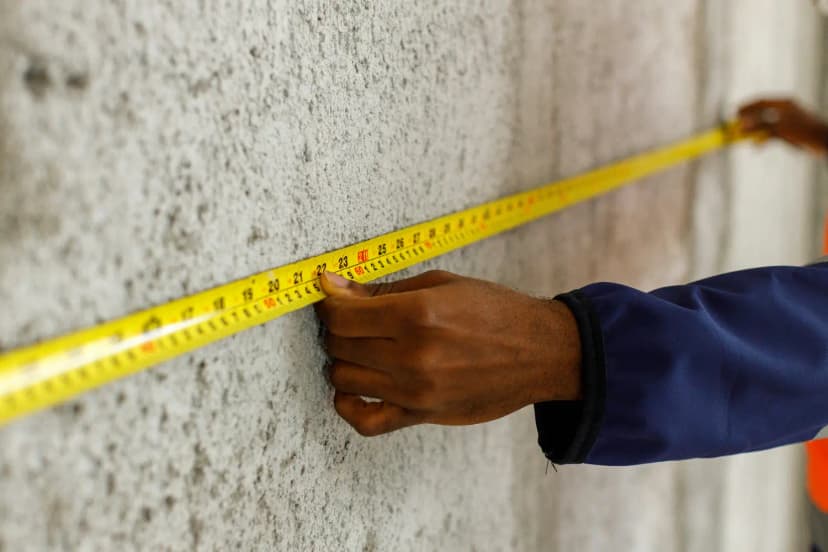
See gallery wall layouts with real sizes — 3, 5, 6, 8, 10+ frames. Match a Framky kit to your wall width, then hang with a 1:1 template.
Give it a try?
See how it works