Short answer: A gallery wall should occupy 50-65% of the width of the furniture below it, and 60-75% of wall width when standing alone. For a 200 cm wall (typical sofa) you comfortably fit 5-7 frames, for 300 cm — 7-9 frames, and for 400 cm — 9-12 frames. The number of frames should be odd if the layout is asymmetric, and even if you're creating a grid.
The question "how many photos to hang?" sounds straightforward, but it's the most commonly asked question about gallery walls — and simultaneously the question the internet answers least specifically. Instead of "it depends on taste," we'll give you exact centimetre numbers, mathematical rules that work, and three counter-examples for when not to apply them.
The 50-65% Rule: How Much Wall Should Your Gallery Occupy
The 50-65% rule is the principle that a gallery wall's width should equal 50-65% of the width of the furniture below it (sofa, bed, chest of drawers, console table). Below 50%, the gallery looks too small and "lost". Above 65%, it starts to visually overwhelm the furniture and breaks the interior composition.
For freestanding walls (without furniture beneath) the rule expands to 60-75% of wall width — a wall without reference point tolerates a more expansive composition.
Table: How Many Frames Fit on Your Wall
The table assumes 5-7 cm gaps between frames and 15-20 cm margins from wall or door edges. The recommended count is optimal visual density; minimum and maximum define the boundaries beyond which the gallery stops working.
| Wall/furniture width | Minimum frames | Recommended count | Maximum | Optimal frame size |
|---|
| 100 cm | 2 | 3 | 4 | 20 × 30 cm |
| 150 cm | 3 | 4 | 5 | 30 × 40 cm |
| 200 cm | 3 | 5-6 | 7 | 30 × 40 cm / 40 × 50 cm |
| 250 cm | 4 | 6-7 | 9 | 40 × 50 cm / 40 × 60 cm |
| 300 cm | 5 | 7-9 | 11 | 40 × 60 cm / 50 × 70 cm |
| 400 cm | 6 | 9-12 | 14 | 50 × 70 cm |
Key principle: One large 50 × 70 cm frame carries the same visual "weight" as two 30 × 40 cm frames. When counting, calculate total surface area too — eight small frames can look less impactful than four large ones.
Odd or Even Number of Frames?
It's a compositional choice, not an aesthetic one. The rule:
- Odd numbers (3, 5, 7, 9) — for asymmetric, organic, "free-flowing" layouts. Odd naturally creates a central point around which the eye builds the composition. Best choice for gallery above sofa, in hallway, on freestanding wall.
- Even numbers (4, 6, 8, 12) — for grid (structured), symmetric, "museum" layouts. Even divides equally into rows and columns for a clean, organised effect. Best choice above chest of drawers, in dining room, minimalist interior.
About 90% of gallery walls people create for the first time look better with an odd arrangement — asymmetry forgives small errors.
How to Calculate a Gallery Above a 220 cm Sofa — Example
A 220 cm sofa is the most common size in British living rooms. Step by step:
- Gallery width = 50-65% × 220 cm = 110-143 cm. Target a composition around 130 cm wide.
- Height of bottom edge = 15-25 cm above sofa back. For a typical sofa (85 cm back height) the gallery's lower edge sits around 100-110 cm from floor.
- Height of centre = 145-155 cm from floor (museum standard).
- Number of frames = 5-6 (see table for 200 cm — sofa width, not wall width).
- Frame size selection: with 5 frames you might use 5 × 30 × 40 cm horizontal, or one 40 × 60 cm + 4 × 20 × 30 cm in asymmetric layout.
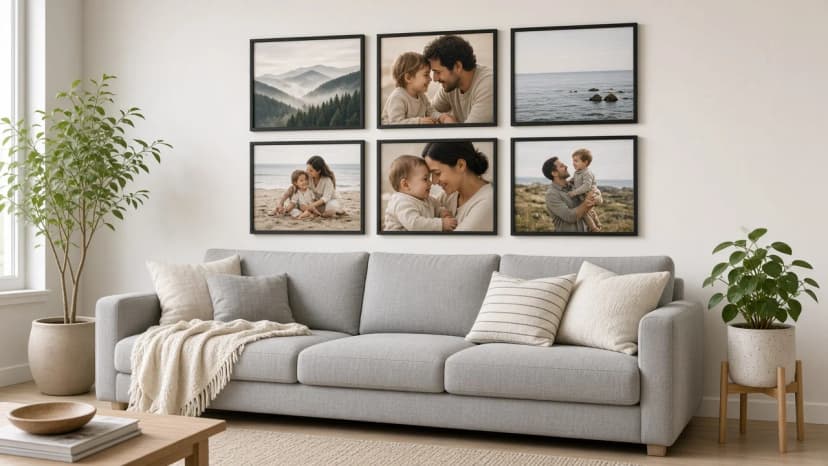
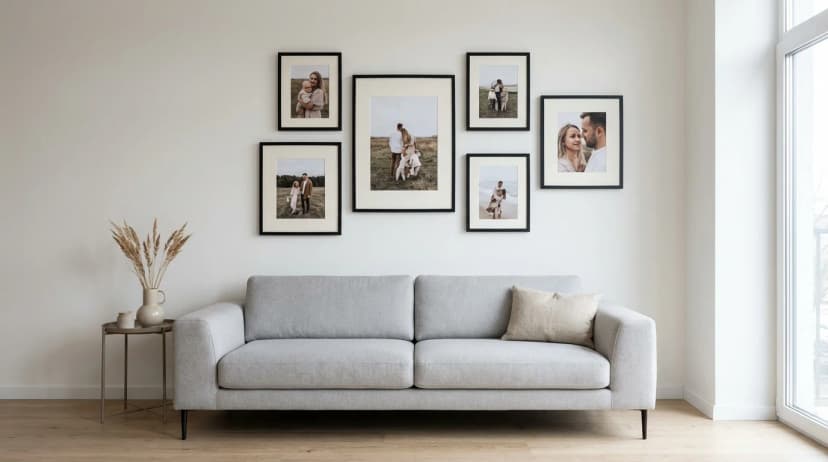
Result: a gallery proportional to the sofa, centred at eye level, with 5 frames creating an asymmetric composition.
3 Common Mistakes with Frame Count
Mistake 1: Too Few Frames for Wall Width
Two 30 × 40 cm frames on a 400 cm wall look like a forgotten experiment. At that width, minimum is 6 frames, recommended 9-12. If you genuinely only have two photos you want to use, skip the gallery — just hang one larger frame (50 × 70 cm or 60 × 90 cm) centred on the wall.
Mistake 2: Too Many Small Frames on Small Wall
15 frames at 13 × 18 cm on a 150 cm wall is "school poster wall." Your brain can't process this much information at once, and it feels chaotic. For a 150 cm wall, stick to 4-5 frames at 30 × 40 cm.
Mistake 3: Random Mix of Sizes with No Logic
7 frames in sizes 13 × 18, 15 × 20, 20 × 30, 30 × 40, 40 × 50, 50 × 70 cm on one wall is a disaster. The eye doesn't know which point is central. If you're mixing sizes, do it mathematically: one "anchor" (largest frame), 2-4 "mid-tones" (second size), 2-4 "accents" (smallest). Three sizes maximum.
Wall Width vs Wall Area: Which Measurement Matters?
For horizontal galleries (e.g. above sofa) wall width determines how expansive the composition can be.
For vertical or grid galleries, the wall area available between furniture and ceiling matters. Standard British ceilings are 2.4-2.7 m; subtract the sofa (85 cm) and margins (25 cm bottom, 30 cm top) and you have realistically 130-145 cm height. Your entire composition must fit in this band.
Quick formula: gallery area (cm²) ≈ 50-65% × wall width × available height. For a 300 cm × 140 cm available height wall, the gallery should occupy 21,000-27,300 cm² of total frame surface.
How to Choose Individual Frame Size for a Gallery
This table helps match frame size to viewing distance — the distance from which guests typically see your gallery, more important than wall width.
| Typical viewing distance | Minimum frame size | Optimal frame size | Too large |
|---|
| 1.0 m (hallway) | 20 × 30 cm | 30 × 40 cm | > 50 × 70 cm |
| 1.5 m (entrance) | 20 × 30 cm | 30 × 40 cm | > 50 × 70 cm |
| 2.0 m (above sofa, seated view) | 30 × 40 cm | 40 × 60 cm | — |
| 3.0 m (living room, standing view) | 40 × 50 cm | 50 × 70 cm | — |
| 4.0 m (large open-plan space) | 50 × 70 cm | 60 × 90 cm | — |
When Less is More: Single-Frame Gallery
Not every wall needs a gallery. One 50 × 70 cm or 60 × 90 cm frame in the centre of a wall in a minimalist interior makes a stronger statement than a 7-frame gallery. When to choose one photo instead of a gallery:
- Wall < 150 cm wide — not enough space for a proper gallery.
- Scandinavian or japandi interior — multiple frames compete with the purity of these aesthetics.
- Wall with strong architectural feature (e.g. exposed brick, concrete, panelling) — the background is already "loud," a gallery adds noise.
- You have one genuinely powerful image — a portrait, travel shot, wedding photo. Don't dilute it with 6 lesser frames.
When the Table Doesn't Apply
These situations break the rules:
- Wall with window or door in centre — the "usable" wall isn't the full width, just the sections either side of the window. Calculate the gallery for each section separately.
- Ceilings > 310 cm (period properties, lofts) — a gallery at eye level (145-155 cm) leaves 150+ cm of empty wall above. Consider a two-tier gallery or single large frame at 80 × 120 cm.
- Studio flat (20 m²) — the rules in this article apply to typical British homes. In a studio, abandon the table and choose 1 large frame + perhaps 2 small accents.
FAQ — Questions Users Ask
How many photos above a 200 cm sofa?
Recommended is 5-6 frames; practically, 3 (minimum) to 7 (maximum). Optimal single frame size for a 200 cm sofa is 30 × 40 cm or 40 × 50 cm. The composition should occupy 100-130 cm width, following the 50-65% rule.
Is even or odd number of frames better?
Odd (3, 5, 7, 9) for asymmetric, free-flowing layouts — creates a natural focal point. Even (4, 6, 8, 12) for grid and symmetric layouts — divides evenly into rows and columns. For your first gallery, choose odd: asymmetry forgives more mistakes.
How many 30 × 40 cm frames fit on a 300 cm wall?
Comfortably 6-7 in one row with 5-7 cm gaps. Maths: 7 frames × 30 cm width + 6 gaps × 6 cm = 246 cm total width. That's 82% of wall width — just over the recommended 65%, but acceptable for a freestanding gallery (no furniture below).
How much wall area should a gallery occupy?
For gallery above furniture — 50-65% wall width × 40-60% available height between furniture and ceiling. For freestanding gallery — 60-75% wall width × 40-60% height. Exceeding these proportions feels "overwhelming"; falling short feels "lost."
Is 3 photos already a gallery?
Yes. A three-frame composition is the smallest formal gallery — it has a central point, two flanking points, and creates a clear visual rhythm. Below three frames it's an "accent," not a gallery. Three frames of the same size (e.g. 3 × 40 × 50 cm) is the safest starting point for first-time gallery builders.
How many photos in a vertical gallery on a narrow wall (80 cm)?
On a narrow, vertical 80 cm wall you fit 3-5 frames vertically. Frame size: 20 × 30 cm or 30 × 40 cm. Vertical spacing: 6-8 cm. Total height of a 4-frame vertical gallery at 30 × 40 cm = 4 × 40 cm + 3 × 7 cm = 181 cm.
What Next
After choosing your frame count, planning the layout and alignment helps — How to Plan a Gallery Wall Step by Step covers this. If you're mixing frame sizes, see The Psychology of Photo Placement for which walls perform best. For galleries in tight spaces, read Gallery Wall in a Hallway and Gallery Wall in an Entrance.
You can design a custom layout in the Framky configurator — choose frame count, sizes and layout, and we print your photos on matte photographic paper and send them with self-adhesive hangers.