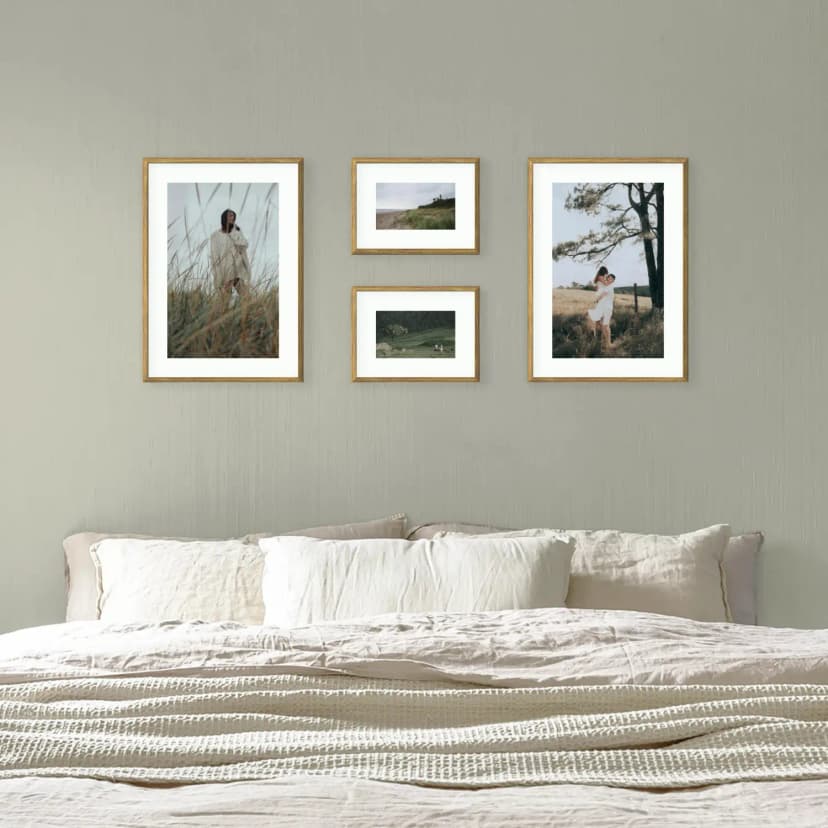
Gallery Wall on a Sloped Ceiling: How to Hang Pictures in an Attic Room
Under a sloped ceiling, hang the gallery on the low knee wall or the gable wall, not on the slope. Heights, layouts and fixings for attic rooms.
6 min read
Article
How to decorate an empty wall step by step — from measuring, through budget and choosing decor, to planning the layout and mounting. Exact dimensions and a ready-made scheme.
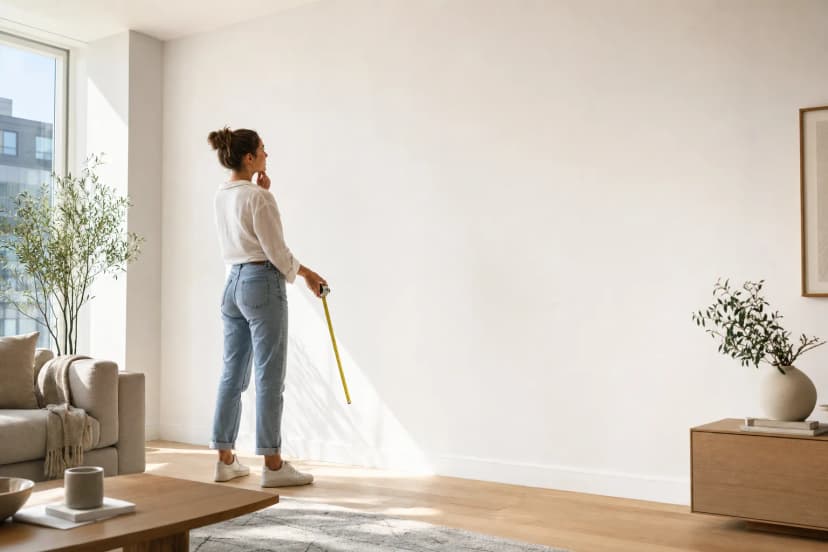
Short answer: You decorate an empty wall in six steps: (1) measure the wall (width × height in cm), (2) determine the room's function and style, (3) set a budget, (4) choose the type of decoration, (5) plan the layout on paper or with a template on the wall, (6) hang it, keeping the gaps to 5–8 cm and the centre of the composition about 145–150 cm off the floor. The most important rule: measure and plan first, only then buy and drill.
An empty wall is paralysing. You know something needs to be done with it, but you're afraid of getting it wrong — decor that's too small, a crooked layout, holes in the wrong place. The good news: decorating a wall is a process that breaks down into simple, measurable steps. This guide takes you through them in order.
Instead of "inspiration", you'll get a decision framework with concrete numbers: how much gap to leave between frames, what height to hang the centre of the composition, and which solution suits which type of wall. At the end you'll find a table matching the solution to the wall size, along with answers to the most common questions.
Take a tape measure and note the width and height of the wall in centimetres. Note the obstacles too: sockets, switches, the radiator connection, the edge of a window. These define the real area you have to work with.
Next, measure the furniture below the wall (sofa, sideboard, console). The width of the decoration should be about 2/3 the width of that furniture. So for a sofa 220 cm wide, the ideal composition is about 145–160 cm wide. It's a simple rule that eliminates the most common mistake — decor that's too small and "gets lost" on a large wall.
Think about what this wall is meant to do. Is it the focal point of the living room that guests are meant to see? Or a narrow strip in the hallway that just needs to liven up the passage? The function decides the intensity of the decoration.
Determine the interior style too: modern, Scandinavian, boho, classic. In a minimalist living room, 3–4 large frames work well; in a classic one, a symmetrical gallery in matching frames. A photo gallery wall adapts to any style through the frame colour (black, white, dark oak, light oak, brushed gold, brushed silver) and the photo tone.
A budget narrows the list of options faster than anything else. A poster or an accent wall in colour costs a few tens of pounds. A photo gallery wall is usually £80–240. Wooden panels across a whole wall can exceed £400.
Remember that wall decoration is an investment for years. A photo gallery has the edge here: you buy the frames once, and you can swap the photos seasonally without changing the frames and without drilling again.
With the measurements, style and budget in hand, pick the solution. The table below matches the type of wall to the recommended decoration.
| Wall type / size | Recommended solution | Why |
|---|---|---|
| Narrow strip above a sideboard (up to 120 cm) | 2–3 frames in a row or one horizontal print | Fills the width without overwhelming |
| Large empty living room wall (200–400 cm) | Photo gallery wall or collage | Fills a large area proportionally |
| Wall above the sofa | Gallery or large print 2/3 the sofa's width | Creates the living room's focal point |
| Narrow hallway wall | A vertical row of 2–3 frames or a mirror | Visually lengthens and brightens |
| Wall along the stairs | A diagonal gallery copying the line of the stairs | Leads the eye and livens up the passage |
| Tall wall (a room with sloped ceilings) | A vertical gallery or one very large print | Uses the height, not just the width |
If you don't know how many frames will fit on your wall and which sizes to choose, the matching quiz below will help.
Seven questions, two minutes. See where you stand before you commit.
This is where success or failure is decided. Never hang "by eye". There are two proven planning methods.
The floor method: lay the frames out on the floor and arrange the composition until it looks good. Take a photo on your phone — it makes recreating the layout on the wall easier.
The paper method: cut rectangles the size of each frame out of kraft paper, tape them to the wall with masking tape and move them around until you find the right layout. Only then hang.
Watch two numbers: the gap between frames of 5–8 cm (equal for all) and the centre of the whole composition at a height of 145–150 cm off the floor. For a gallery above a sofa, the lower edge of the decoration should be about 15–25 cm above the backrest. You can read about aligning frames of different sizes in how to align frames of different sizes on a wall.
With a plan in hand, mounting is a formality. You hang a Framky photo gallery on self-adhesive hangers (included) — no drilling. They won't damage the wall, provided the paint is firmly bonded to the plaster and the plaster itself is stable. It's the ideal solution for renters and anyone who doesn't want to drill.
If you prefer traditional fixing, each frame can be hung on 2 nails in the inner corners (nails not included). Start with the central, most important frame, and add the rest around it, measuring the gaps with a spirit level.
Three mistakes spoil most arrangements. First, decor that's too small — a single small frame on a large wall looks lost. Second, hung too high — a composition centre above 160 cm forces you to tilt your head back. Third, uneven gaps — random distances between frames make it look messy.
All three come from skipping steps 1 and 5: measuring and planning. That's why this guide puts so much weight on them.
The centre of the whole composition should sit at a height of about 145–150 cm off the floor — the eye level of a standing person. Above a piece of furniture (a sofa, a sideboard), the lower edge of the decoration should be about 15–25 cm above the top or backrest, so the decoration and the furniture form one visual group.
The optimal gap is 5–8 cm, equal for all frames in the gallery. A smaller gap feels cramped, larger than 10 cm breaks the composition into separate, unconnected elements. Stick to one consistent value across the whole gallery.
The simplest way is a photo gallery on self-adhesive hangers — mounting with no holes, ideal for renters. You can also hang posters, light mirrors and prints without drilling using mounting tape. The condition for self-adhesive hangers: the paint must be firmly bonded to the plaster and the plaster itself stable.
A large wall (200–400 cm) is best filled with a photo gallery wall or a collage — they take up the area proportionally and create a focal point. A single small picture on such a wall looks lost. Remember the 2/3-of-the-furniture-width rule.
Cut rectangles the size of the frames out of paper, tape them to the wall with masking tape and move them around until you find the right layout. Only then hang. Alternatively, lay the frames out on the floor, arrange the composition and photograph it on your phone before transferring it to the wall.
A decoration above furniture should be about 2/3 of its width. For a 220 cm sofa that's a composition about 145–160 cm wide. On a standalone wall (with no furniture), the decoration can take up more of the area, but always leave free "breathing room" at the edges and the ceiling.
Once you have a plan, choose the number and sizes of frames in how many photos in a wall gallery. For a detailed overview of ideas, turn to living room wall ideas, and if you rent, see a photo gallery wall in a rental property. You can read about aligning frames of different sizes in how to align frames of different sizes.
You can plan the whole gallery layout — with a preview on the wall and no-drill mounting — in the Framky configurator.
Sign up and we'll send you a code with a bigger discount than the shop offers — plus occasional inspiration for your photo gallery wall.
Under a sloped ceiling, hang the gallery on the low knee wall or the gable wall, not on the slope. Heights, layouts and fixings for attic rooms.
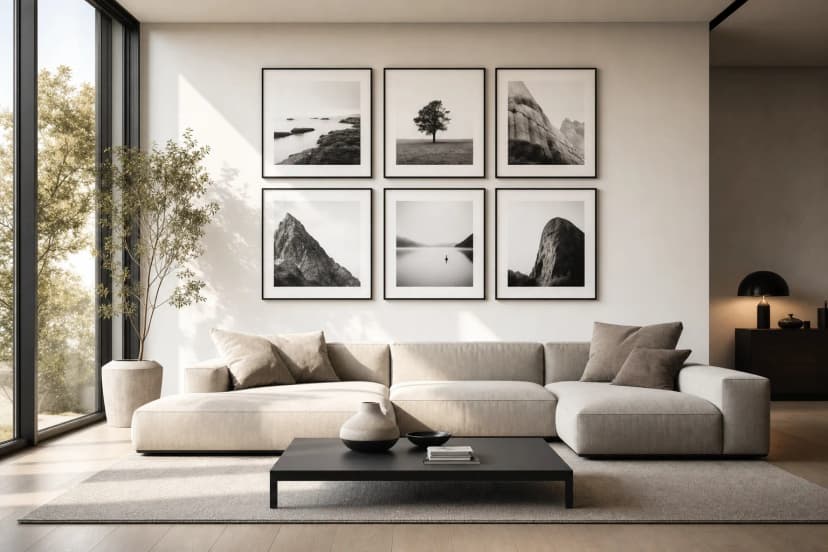
Treat the TV as one frame: centre the gallery on the screen, align edges, keep equal gaps and use larger frames near it. Four layouts that work.
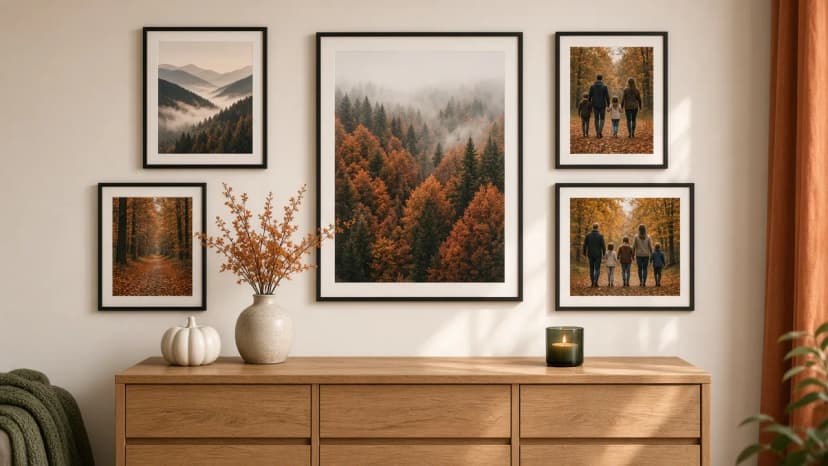
Autumn wall decorations without new frames: swap 2–3 photos in the gallery for forest, misty mountains, night sky and winter photographs from Framky Artists. How many to change, which palette, and when to return to the spring set.
Give it a try?
See how it works