Photos above your desk affect concentration — what research shows. Choice of subject, glare-free zones, proportions and 4 common mistakes.
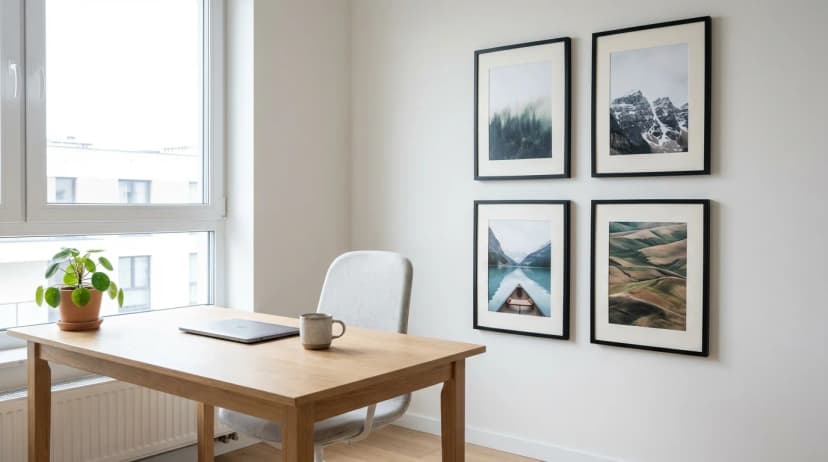
Short answer: Photos on a wall in the home office affect measurable stress levels and concentration ability — according to a meta-analysis by Kweon and colleagues (Environment and Behavior, 2008), the presence of nature images in a work space reduces self-reported stress by 13–19%. Optimal setup: 3–5 frames on a side wall (never opposite the monitor — glare), mixed subject matter (60% nature and landscapes, 30% personal memories, 10% accent), centred at 140–150 cm height.
Remote working in the UK has become standard for many professions since 2020 — which means the home office has gone from luxury to a room where we spend 6–10 hours daily. The walls of this room work alongside us: they influence how often we take breaks, how quickly we return to a task after distraction, and how we experience work-related stress. This article is about using this influence consciously.
What is "environmental exposure" in the context of work?
Environmental exposure is a term in environmental psychology meaning passive, everyday contact with elements of the surroundings — without conscious viewing. Photos on an office wall are a classic example: you look at them incidentally, lifting your eyes from the screen, and they work through regular, brief exposures. It is involuntary exposure, not contemplation — and this is why it works over long periods, not in single "viewing sessions."
What research says about photos in the workplace
Three studies frame the science behind this topic:
- Kweon, Ulrich, Walker, Tassinary (2008) in Environment and Behavior — participants in work spaces with nature images reported lower stress levels (a reduction of 13–19%) and less intense anger compared with abstract or empty spaces.
- Berto (2005) — brief exposure to images of natural environments improves attention test results after periods of demanding cognitive work. The mechanism: Kaplan's Attention Restoration Theory — nature images engage involuntary attention, freeing resources for focused attention.
- Ulrich (1984) in Science — although the study concerns a hospital, it is the most frequently cited evidence for the therapeutic effect of nature views. Patients with a view of trees required fewer painkillers than patients with a view of a wall.
Key principle: Nature images in the office are not "decoration" — they are an attention recovery tool. A few seconds looking at a forest photograph during a break between tasks activates different attention networks than screen work, giving your brain a micro-rest.
Why photos opposite the monitor is the worst choice
One of three rules we do not negotiate: never hang a gallery on the wall you see directly behind your monitor. Four reasons:
- Glare — every ceiling light and every window behind you reflects in frames with glass. Framky frames are without glass, so this problem is minimal, but the wall behind your monitor is still "dead viewing space."
- Competition with screen — your eye must constantly decide what to focus on (screen or photos), which increases visual load.
- Lack of contrast — after 6 hours staring at a screen, your brain needs visual change, not an extension of the scene you already see.
- Unnatural height — the wall behind your monitor is normally viewed straight ahead, which forces the gallery centre to 110–120 cm (eye level when seated). This is too low aesthetically.
Three good locations for a gallery in a home office
Location 1: Side wall (right or left of the desk)
Best choice in 80% of cases. When you lift your eyes from the screen and look to the side, you see the gallery — this is the ideal moment for a 2–5 second attention recovery.
Recommendation: 3–5 frames, centred at 140–150 cm height, 80–150 cm from the desk.
Location 2: Wall behind you (seen when turning)
Less obvious, but works well for people who consciously "turn around" during breaks. It gives complete eye relief from the screen.
Recommendation: 4–7 frames — this wall is usually the longest in an office, so you can use a larger composition.
Location 3: Wall beside a window (beside, not opposite)
If your desk sits perpendicular to a window, a gallery on the wall beside the window gets the bonus of natural daylight on the frames throughout the day. You need to watch for the zone where direct sunlight falls — UV fades colours.
Recommendation: 2–4 frames, away from direct sunlight (> 80 cm from the window).
Table: photo subject matter and office purpose
| Psychological goal | Recommended subject | Proportion | Notes |
|---|
| Stress reduction | Nature landscapes (forest, mountains, water) | 40–60% | Strongest effect according to research |
| Attention recovery | Soft nature images, without sharp contrast | 30–50% | Kaplan Attention Restoration |
| Personal motivation | Favourite places, travel goals, passion | 20–30% | "Reminder why I work" |
| Sense of belonging | Close family, friends | 10–20% | Supportive, but do not dominate |
| Creativity | Abstraction, art, street photography | 10–20% | Only if you work creatively |
Step by step: how to plan a gallery in your office
- Measure your desk and its position in the room. Where is your monitor? Which direction do you face while working? Which way can you turn your eyes?
- Choose a side wall (left or right of you, visible when lifting your head from the screen).
- Check lighting conditions — does this wall get direct sunlight? If so, choose the other side or leave an 80 cm margin from the window.
- Choose subject matter — predominantly nature (60%), add 1–2 personal accents (20–30%), optionally 1 abstract or creative work (10%).
- Choose frame size — for a 6–12 m² office, 30 × 40 cm is optimal. Larger (40 × 60 cm) as a composition anchor.
- Plan 3–5 frames — a smaller number works better in an office than a large gallery. An office is a space for focus, not display.
- Mount on self-adhesive hangers and leave paper templates in place for 48 hours before final installation.
Four common mistakes in office galleries
- Too many frames. 10–15 photos above a desk is visual noise that competes with the screen. Stick with 3–5 shots.
- Frames with sharp contrast or aggressive colours. Dark reds, oranges, overly saturated photos stimulate rather than relax. For the office choose muted palettes.
- Family photos only. A family gallery in an office, which is "your professional space," can be emotionally distracting during important work. Better: a mix — 20% family + 60% nature + 20% passion.
- Motivational quotes and slogans. "Dream Big," "Hustle Hard" — this is visual poison after 2 weeks. Research does not support any positive effect from such posters; it does support the effect of nature images.
What about frames without glass in the office
The absence of glass in Framky frames is doubly valuable in a home office:
- No glare from desk lamps and ceiling lights — every frame with glass in an office is a mini-mirror that reflects your working light. Frames without glass do not.
- No glare from screen light — if the gallery is in your peripheral vision, frames with glass reflect blue screen light and distract. Matte frames remain visually stable.
When a gallery in the home office will not work
- Office is "a corner in the lounge" — one desk in a corner of the living room. In this case, a gallery must work in both the lounge function and the office function. We wrote about this in How many photos in a wall gallery.
- Office with three people on video calls at once — a gallery behind you becomes the background of every conversation, which requires different logic (see "video call background" section below).
- Office without daylight (basement, windowless room) — frames will be lit only by artificial light, which flattens colours. You need to choose a good lamp above the gallery.
Video call background — if you work on camera
A gallery behind you during video calls is like a mini business card. Three rules:
- The wall behind you must be WELL lit — otherwise the gallery looks dull and unclear in the camera frame.
- Subject matter must be universal — no very personal photos, nothing controversial. Landscapes and neutral shots are safe.
- Not too many frames — 3–4, so as not to distract the other person.
FAQ — questions users ask
Do photos in the office distract?
In research on the impact of images on cognitive work, nature photos not only do not distract but support focused attention recovery (Kaplan, Attention Restoration Theory). The key is placing them outside your direct line of sight while working — on a side wall or behind you, not behind the monitor.
What colours in photos are motivating?
Muted, with dominant greens (nature), blues (water, sky) and warm earth tones. Avoid strong reds and oranges — they are psychologically stimulating, which is counterproductive in the office. Black and white photography also works very well, especially portraits and landscapes.
How many photos in a home office is optimal?
3–5 frames is the optimal range for a typical home office of 6–12 m². Below 3 the gallery loses coherence, above 5 it becomes visual noise competing with the screen. Larger offices (> 15 m²) tolerate 5–7 frames.
Can I hang family photos above my desk?
Yes, but limit to 1–2 frames, do not build a "family gallery" in your office. Photos of loved ones activate emotional brain networks, which is supportive during breaks but can be distracting during intense work. Optimal: 60% nature, 20–30% personal, remainder accent.
How high above the desk should I hang frames?
If the gallery is on a side wall — centred at 140–150 cm (museum standard, independent of the desk). If, exceptionally, you make a gallery above the desk (the wall opposite, despite our advice), the centre should be at 120–130 cm — a compromise between museum standard and the eye level of a seated person.
Are nature photos really better than abstraction?
In the context of stress reduction and attention recovery — yes, the evidence is strong. Meta-analyses in environmental psychology consistently show the advantage of nature images over abstraction and non-natural art. For creativity the results are less clear — some research suggests abstract art may support divergent thinking. If you work creatively, you can mix.
What next
A deeper analysis of the psychological impact of photos on wellbeing can be found in Psychology of photos on walls and wellbeing. To choose the right wall, see Psychology of photo placement. If your office is small and you need to calculate proportions exactly, How many photos in a wall gallery will be helpful.
Design a gallery for your home office — with MDF frames without glass, no glare from desk lamps — in Framky's configurator.