Can you hang framed photographs in a bathroom? How humidity impacts photographic paper and MDF, alternative locations, and honest assessment of durability.
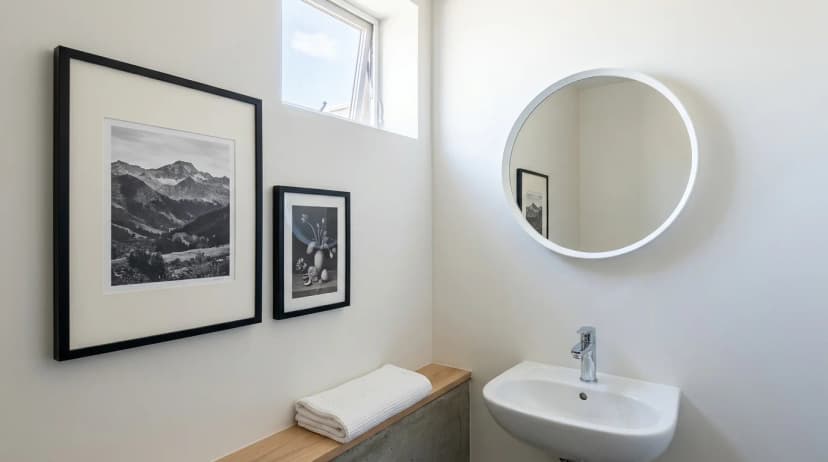
Short answer: A photo gallery wall in a bathroom is a good idea only in a guest bathroom (without shower and bath) or in the main bathroom with exceptionally good mechanical ventilation and humidity below 65% RH for most of the day. In a bathroom with a daily-use shower and no window, MDF frames and photographic paper lose durability within 6–18 months. This is one of those cases where the honest answer is "better not".
Most articles on bathroom decoration say "yes, you can hang photographs, use water-resistant frames". We go against the grain, because the truth is less colourful: most British bathrooms are not a good place for photographs in MDF frames. Humidity after a shower often exceeds 80% RH for 20–40 minutes, and condensation on the cooler wall can create tiny droplets invisible to the naked eye. This article will help you assess whether your bathroom is one of the rare ones where a gallery has a chance of surviving — or whether a different location in your home would be better.
What makes a "safe bathroom" for frames with photographic paper?
A safe bathroom for MDF frames is a sanitary room where air humidity drops to 50–60% RH within a maximum of 30 minutes after a shower, thanks to effective mechanical extraction or an open window. Only in such conditions does matte photographic paper retain dimensional stability and MDF profiles resist swelling.
How humidity affects photographic paper and MDF
BS EN ISO 7730 defines comfortable humidity for residential rooms as 30–65% RH. Above 70% RH, material problems begin:
- Photographic paper — absorbs moisture from the air, leading to subtle waviness on the surface and over time, loss of colour saturation. Under conditions of 70–85% RH for several hours daily, effects become visible within 6–12 months.
- MDF (medium-density fibreboard) — absorbs moisture from the edges (which are unvarnished). Edge swelling is the first sign; in extreme cases, it leads to layer delamination.
- Adhesive in self-adhesive hangers — most acrylic adhesives lose 20–40% of holding strength at constant humidity > 70% RH.
Key principle: One steamy bath won''t destroy a gallery. Daily baths without effective ventilation over 6–18 months — yes. It''s a war of endurance, not intensity.
Table: bathroom types and recommendations for frames
| Bathroom type | Average max. humidity after use | Time to return < 60% RH | Recommendation |
|---|
| Guest bathroom (WC and sink only), with extractor | 50–60% RH | < 5 min | Yes — safe |
| Guest bathroom with open window | 50–55% RH | < 10 min | Yes — safe |
| Main bathroom with shower and mechanical extractor, in apartment block | 75–85% RH | 30–60 min | Conditional, frames in dry zone |
| Main bathroom with shower and open window (once daily) | 80–90% RH | 20–40 min | Conditional, only in zone 2 |
| Main bathroom with bath and shower, no window, poor extraction | 85–95% RH | > 90 min | No — do not hang frames |
| Bathroom in detached house with large south-facing window | Variable | Very quick | Conditional, watch for UV and condensation |
Three zones in a bathroom: from safe to risky
Zone 1: Dry (safe)
Wall near the bathroom entrance, at distance > 3 m from shower and bath, > 2 m from sink. In most British bathrooms, this zone is 0–2 m² of wall by the door.
Recommendation: 1–3 smaller frames (20 × 30 cm or 30 × 40 cm) at eye level.
Zone 2: Semi-dry (conditional)
Wall 1–2 m from sink, but > 2 m from shower. Slight condensation may occur after longer showers. Touch the wall five minutes after a shower — if you feel moisture, don''t hang frames.
Recommendation: one small frame (20 × 30 cm), never a full gallery.
Zone 3: Wet (forbidden)
Wall within 1 m of shower, bath, or shower enclosure. Heavy condensation, sometimes direct splash, worst thermal conditions (temperature fluctuations 5–10 °C between morning and evening).
Recommendation: never hang framed photographs with photographic paper in this zone.
How to check if your bathroom qualifies: 3-day test
Before you buy frames, do a simple test:
- Day 1: Hang an inexpensive humidity meter (£10–30 in supermarkets) on the wall where you plan the gallery. Height 150 cm from the floor.
- Days 1–3: Use the bathroom normally — shower, teeth brushing, everything as usual. Record the reading three times daily: before shower, five minutes after shower, one hour after shower.
- Positive result: If all "one hour after shower" readings are < 60% RH, your bathroom qualifies for a gallery in zone 1.
- Negative result: If even one "one hour after shower" reading exceeds 65% RH, do not hang frames. Choose an alternative.
Three alternatives if your bathroom doesn''t qualify
Alternative 1: Poster or photograph in an aluminium frame with acrylic
An aluminium frame with acrylic (not glass) is hermetic and moisture-resistant. This is NOT a Framky product, but we honestly recommend this type if you want artwork in your bathroom. They look "poolside" and don''t suit every style, but they''ll survive.
Alternative 2: Gallery in the hallway on the way to the bathroom
Often the best solution. A hallway gallery is viewed both entering and leaving the bathroom, and works as an emotional bridge between the room and the sanitary zone. See Photo gallery walls in hallways.
Alternative 3: Smaller decoration — a single memento, not a gallery
A shelf with 2–3 favourite items (candle, ceramic, dried flower bouquet) gives the space personal character without the risk of paper damage. Perfect for bathrooms where you want to "add soul" but don''t want to battle physics.
When a bathroom gallery is still a good idea
Three specific situations where we say "yes, try it":
- Guest bathroom with WC and sink in a home where guests use it occasionally. Low humidity, quick return to normal.
- Main bathroom in a detached house with very good mechanical extraction connected to a separate channel vented outside, running for 30+ minutes after each use. Mainly found in homes built after 2015.
- Bathroom with a large window opened after every shower — full natural ventilation works very effectively, though challenging in British winters.
When a bathroom gallery is a bad idea
- Bathroom in an apartment block from 1970–1990s. Mechanical extraction standards from that period are insufficient. Humidity persists long after a shower, and some flats have documented damp problems.
- Bathroom without a window. No natural ventilation = complete dependence on mechanical extraction, which usually can''t keep up.
- Bathroom used by more than 2 people, with 3+ showers daily. Humidity never drops to safe levels between uses.
- Bathroom with a power shower or hydromassage bath. Most steam, longest drying time.
FAQ — questions our users ask
How long will an MDF frame last in a bathroom?
In a guest bathroom (humidity < 60% RH most of the day) — 5+ years without visible changes. In a main bathroom with mechanical extraction and humidity 60–70% RH — 1–3 years, with progressive edge swelling. In a bathroom without extraction and regularly > 75% RH humidity — 6–18 months until visible damage.
Will matte photographic paper withstand steam?
Short-term — yes. Long-term and repeated — no. Photographic paper absorbs moisture from the air, leading to subtle waviness and in the long run, colour loss. Pigment printing with a set of 12 inks is more resistant than dye-based printing, but still has its limit around 70% RH for several hours daily.
Can I use glass-fronted frames in a bathroom?
Glass seals the front of the frame, but not the back or edges. Moisture still gets to the paper through the gap between the frame and the backing card. Plus, glass creates strong reflections in a bathroom lit by wall lights, which is visually unpleasant. An aluminium frame with acrylic (hermetic) is definitely a better choice.
What about posters in hotel bathrooms? Why do they work?
Hotels use aluminium frames with acrylic and often laminated prints (not photographic paper). It''s a completely different technology, far more moisture-resistant — and much more expensive per frame. Framky is built on classic photographic paper and MDF frames, designed for living-room conditions.
Is a gallery above the WC in a guest bathroom a good idea?
Yes, if the WC is separated from the shower zone by a wall or is in a separate room (guest toilet). 1–3 frames above the WC work as an aesthetic accent, and humidity in a guest toilet rarely exceeds 55% RH.
How long should the extractor run after a shower?
Minimum 20 minutes after leaving the bathroom, ideally 30 minutes. In practice: after your shower, leave the extractor running and leave — don''t turn it off "because it''s annoying". Some newer extractors have a delayed-switch function with a timer.
What next
If your bathroom doesn''t qualify for a gallery (and most British bathrooms don''t), start with Photo gallery walls in hallways — a hallway is often the nearest "safe" location to the bathroom and works as its natural complement. If you''re thinking about a gallery elsewhere, check out Photo gallery walls in kitchens, which has similar environmental constraints to bathrooms but more safe zones.
Galleries designed for living-room conditions (dry, stable) are best planned in Framky''s configurator — MDF frames, pigment printing with a set of 12 inks, self-adhesive hangers.