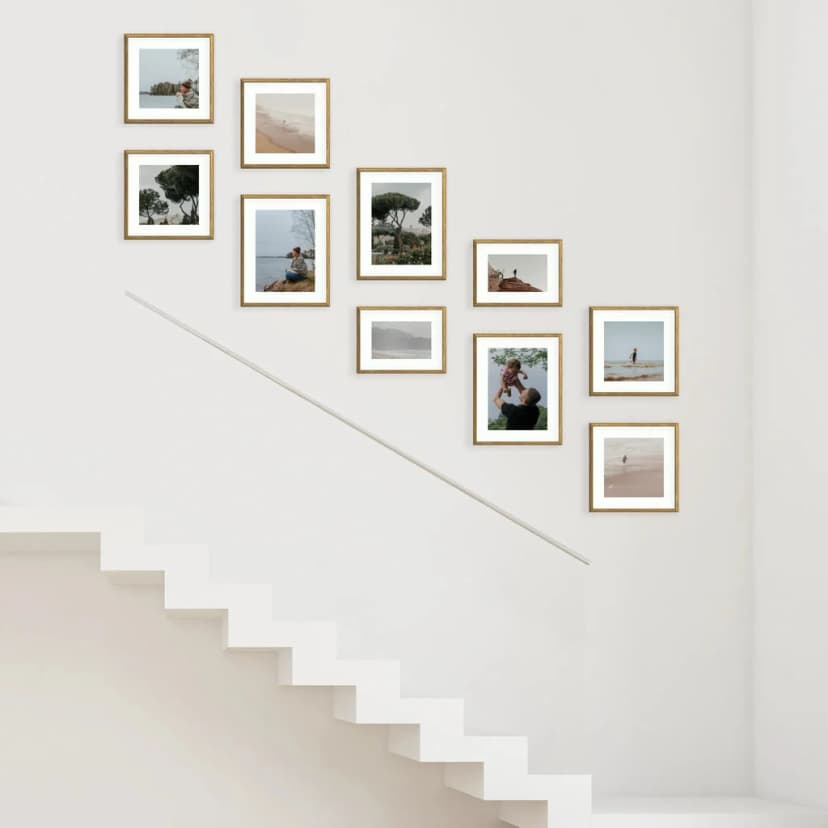
How to Hang a Photo Gallery Wall on Stairs
Hang a staircase photo gallery in about 15 minutes: measure the rise, pick a stepped layout, use Framky’s 1:1 template — no drill.
5 min read
Article
You have 500 wedding photos from photographer and don''t know which go on wall. Selection framework: 9 from 500 — 7 moments of wedding day, 3 selection pitfalls.
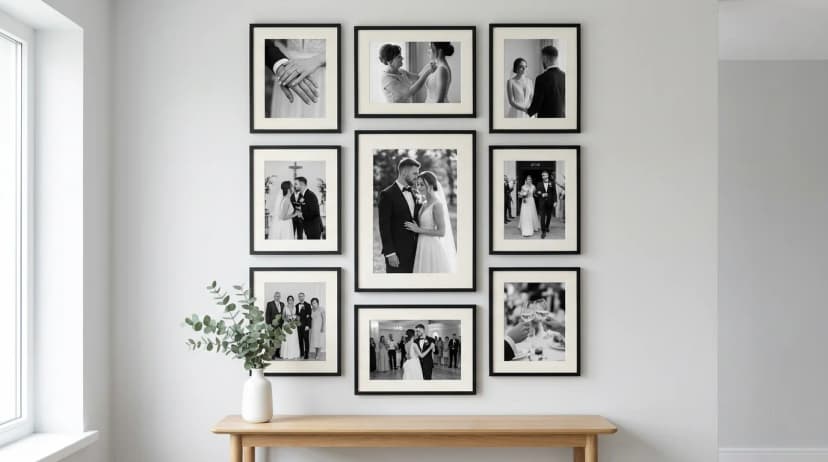
Quick answer: From 500 wedding photos to wall goes 9 — one for each key moment: preparations (1), first look (1), ceremony (2), couple portraits (1), family (1), reception (1), first dance (1), evening departure (1). Frames 30 × 40 cm in 3 × 3 grid layout. Order photos in high resolution (minimum 3000 × 2000 px) directly from photographer — Instagram size is too small to print.
A typical UK wedding photographer delivers 300–800 photos from one day. Most couples browse them once a week after wedding, then they sit in Google Drive and never return to wall. Shame: these are the most expensive photographs in your life (literally — photographer cost, preparations, planning), and their true value appears only when they become part of daily home life. This article shows how to choose those 9 frames that truly belong on your wall.
Narrative selection of wedding photos is a method of choosing prints where each photo represents different moment of the wedding day, creating together a visual story "from preparations to end". Unlike aesthetic selection ("choose 9 most beautiful"), narrative leads viewer through full day, building stronger memories and working on guests who see moments they personally remember.
These 7 moments form "core" of most UK weddings — registry office and church, large and intimate. From each moment you choose 1 photo for gallery. Remaining 2 from 9 are "free" — for what mattered most to you (surprise, intimate moment, small gesture).
What you seek: final half hour before leaving for registry/church. Bride in dress but not final makeup. Groom with tie in hand. Mother fixing daughter''s hair. Friends with champagne.
Typical frame: mother/sister fastening bride''s dress. Detail of hands, 30 × 40 cm frame.
What you seek: moment couple first sees each other that day. If you had "first look" before ceremony — that one. If not — bride entering registry/church when groom turns.
Typical frame: groom''s expression at turning. One of emotionally strongest shots of entire day.
What you seek: moment of exchanging vows. Couple''s hands joined or holding rings.
Typical frame: hands and rings. Hand shots are timeless (don''t age like portraits) and look brilliant at 30 × 40 cm.
What you seek: moment of first kiss as married couple.
Typical frame: half-profile of couple in profile or three-quarter view, guests blurred in background. Frame 30 × 40 cm or larger.
What you seek: 15–30 minutes after ceremony photographer usually does portrait session in garden or indoors. Choose one favourite from this session.
Typical frame: portrait, half-body or three-quarter body, simple background. This photo is most often printed as gallery "anchor frame" (composition centre).
What you seek: one from all family photos that is least stiff. Most "family" shots look like "please stand together and smile" — choose one where at least one person genuinely laughs.
Typical frame: parents and siblings of both sides with couple. Frame 30 × 40 cm.
What you seek: evening''s climactic moment. First dance, father''s toast, shared laugh.
Typical frame: first dance in room lighting (usually warmer). Gives contrast to cooler portrait session colours — good for gallery as it introduces variety.
| Gallery position | Day moment | Frame size | Role in composition |
|---|---|---|---|
| Centre (anchor) | Couple portrait | 40 × 60 cm | Central point |
| Top left | Preparations | 30 × 40 cm | Narrative beginning |
| Top centre | First look / entrance | 30 × 40 cm | First emotion |
| Top right | Ceremony — vows | 30 × 40 cm | Official moment |
| Middle left | Ceremony — kiss | 30 × 40 cm | Culmination |
| Middle right | Family | 30 × 40 cm | Social context |
| Bottom left | Reception — toast or laugh | 30 × 40 cm | Evening joy |
| Bottom centre | First dance | 30 × 40 cm | Evening intimacy |
| Bottom right | Departure / final moment | 30 × 40 cm | Narrative closure |
Key principle: In wedding gallery central portrait (40 × 60 cm) should be visibly larger than others — it''s narrative "hero" around which rest of story builds. All 9 frames same size gives "documentary grid" effect, which is less emotional.
Most UK wedding contracts include "delivery of high-resolution photos" as standard. If not, send simple message:
"Hi [Name], we''d like to print 9 photos from our wedding at 30 × 40 cm and one at 40 × 60 cm for a wall gallery. Could you send these specific shots (list in attachment) in full resolution (minimum 3000 × 2000 px)? Thank you!"
Standard fee is usually nothing (included in session price), sometimes £20–60 as "additional service". Some photographers offer printing and frames — worth asking but not mandatory.
Portrait session after ceremony yields 50–100 brilliant couple shots. Temptation to make gallery from only portraits. Don''t — 9 portraits of same couple in different poses is boring gallery. Even beautifully shot photos lose value without contrast from other moments.
Some photos are aesthetically perfect (composition, light, colour) but personally meaningless. Others are technically average but show moment you''ll remember lifetime. Gallery of "choose heart, not eye" works better long-term.
"Must show my family." "Must show her family." "Must add grandmother or she''ll be offended." Result: 4 of 9 shots are stiffly posed family photos that aesthetically damage gallery. Rule: maximum 1 family photo in 9-frame gallery. Rest go in album.
Optimally 7–9 shots. Below 7 gallery loses narrative character (not enough shots to tell day). Above 9 becomes "wallpaper" without clear points. Framework 7 wedding day moments + 2 "free" shots gives stable balance.
Most UK wedding photographers deliver full resolution (6000 × 4000 px or higher) as part of contract. If you got only "preview" (1200 × 800 px), that''s screen resolution — message photographer asking for full files. Rarely requires extra fee, usually already in standard contracts.
Shots with sharp side light (window, golden hour outside), ring-on-hands detail, profile couple portraits with blurred background, wide ceremony shots from guest perspective. Worse: shared selfie with phone, weak artificial hall light without photographer flash, "family" photos with harsh flash.
As central "anchor" of 9-frame gallery 40 × 60 cm is optimal. Remaining frames around it 30 × 40 cm. In larger home (> 50 m²) you can go 50 × 70 cm as anchor. In studio flat (< 35 m²) 40 × 50 cm better — larger dominates.
Both work. Colour keeps day''s authenticity (dress, flowers, room lighting). Black & white is more "timeless" and better withstands style aging. Compromise: 6 colour + 3 black & white, alternating in gallery. We wrote more about this in Black & white or colour — psychology.
Yes and no. It''s classic and every couple has one. But also one of most emotionally genuine shots of entire day — brain reacts strongly even after 10 years. Cliché? Yes. Worth hanging? Absolutely, if it''s well shot. Classic works because it works.
After choosing wedding photos think about composition layout — helpful: How to align frames of different sizes. For choosing frame count relative to wall width see How many photos in gallery. If you live in smaller home and unsure if 9-frame gallery fits, check Gallery in small home up to 40 m².
Your wedding gallery matched to your 9 chosen shots — printed on matte photographic paper with pigment inks for colour accuracy — you''ll design in Framky configurator.
Sign up and we'll send you a code with a bigger discount than the shop offers — plus occasional inspiration for your photo gallery wall.
Hang a staircase photo gallery in about 15 minutes: measure the rise, pick a stepped layout, use Framky’s 1:1 template — no drill.
Hang a photo wall in the stairwell: measure the rise, pick a layout along the banister, use a 1:1 template. No drill, about 15 minutes.
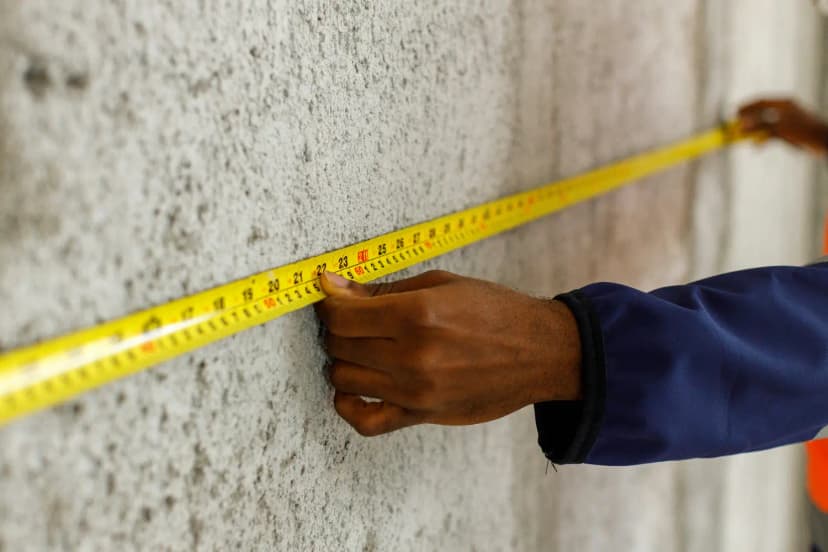
See gallery wall layouts with real sizes — 3, 5, 6, 8, 10+ frames. Match a Framky kit to your wall width, then hang with a 1:1 template.
Give it a try?
See how it works