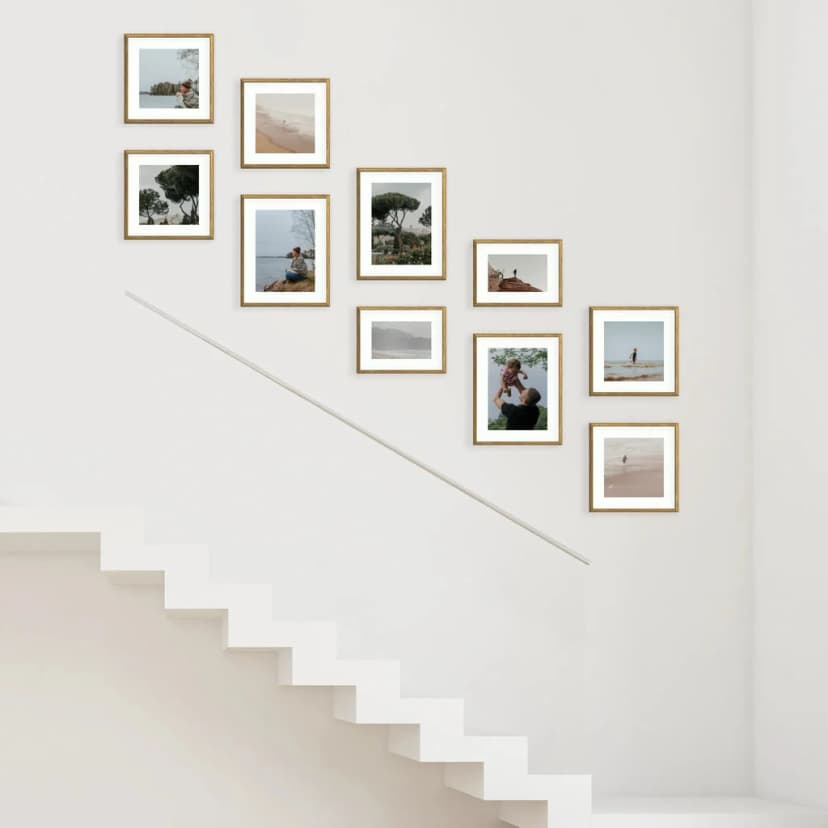
How to Hang a Photo Gallery Wall on Stairs
Hang a staircase photo gallery in about 15 minutes: measure the rise, pick a stepped layout, use Framky’s 1:1 template — no drill.
5 min read
Article
Which wall frames should you choose? A practical guide to materials, colours and sizes — with tables matching frame colour to your interior style.
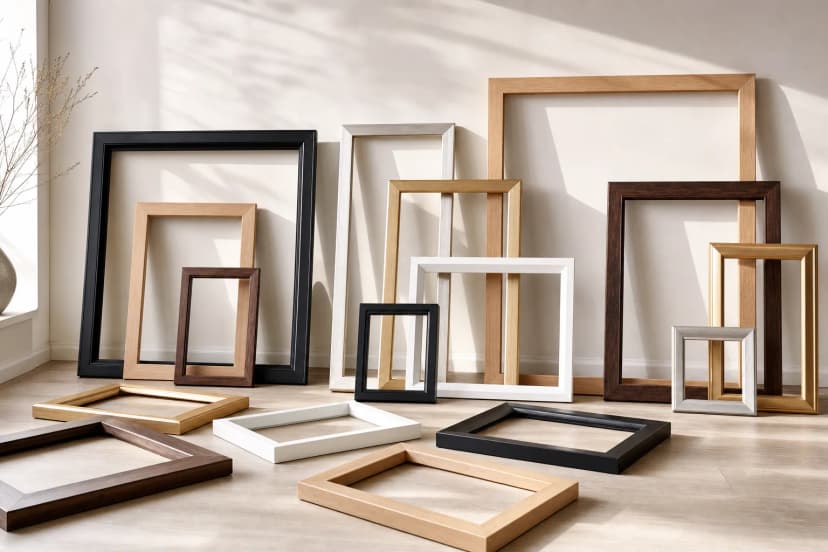
Short answer: When choosing wall frames, be guided by three things: material, colour and size. The best compromise between quality and price comes from MDF profiles — they're dimensionally stable, smooth, and neither warp like solid wood nor look cheap like plastic. Match the colour to the dominant tone of the room (black and white are universal, oak warms things up, brushed gold and brushed silver work as an accent). Size depends on the wall: above a sofa, 40 × 60 or 50 × 70 cm works well. Frames without glass eliminate light reflections and show the photo cleanly — that's the single most important difference in quality you'll notice on the wall.
The question "which wall frames to choose" seems simple until you're faced with hundreds of options that differ in material, colour, profile width and whether or not they have glass. This guide organises the decision around three criteria that genuinely matter: what the frame is made of, what colour it is, and what size it is.
Instead of generalities, we give you concrete recommendations, two matching tables, and the most common questions people ask when planning wall decoration. At the end you'll find tips on how to assemble individual frames into a coherent photo gallery wall.
The frame's material affects its durability, appearance and how it's mounted. The three most popular options are MDF, solid wood and plastic — and they differ more than the price suggests.
MDF profiles are a board made of wood fibres of uniform density, lacquered or foil-finished smooth. The main advantage: dimensional stability. MDF doesn't move with changes in humidity, doesn't crack and doesn't warp, so the frame's edges stay straight for years. The surface is even, with no knots or grain, giving a clean, modern look. MDF is also lighter than solid wood, which means it holds better on self-adhesive hangers.
Solid wood looks refined, but has two drawbacks: it's more expensive and can be temperamental — in the dry air of the heating season it can deform, and every piece has a different grain, so two "identical" frames don't always look the same. Plastic is the cheapest and lightest, but the surface often looks cheap and the colours fade in the sun.
In Framky frames we use MDF profiles in six colours, certified FSC MIX — responsible forest management. It's a deliberate choice: we want a gallery that looks good and keeps its proportions for 10+ years.
Frame colour is an aesthetic decision, but not an arbitrary one — it should talk to the dominant tone of the room, not to the colours in the photo. The available MDF profile colours are: black, white, dark oak, light oak, brushed gold and brushed silver.
The rule is simple: if the interior is cool and modern (whites, greys, concrete), reach for black, white or brushed silver. If it's warm and natural (wood, linen, greenery), oak or brushed gold fits. Black and white are the safest — they work in almost any style.
| Frame colour | Matching interior style | Effect |
|---|---|---|
| Black | Modern, industrial, minimalist | Strong outline, emphasises the photo |
| White | Scandinavian, light, classic | Lightness, the frame "disappears", the photo takes over |
| Dark oak | Classic, rustic, warm | Natural warmth, cosiness |
| Light oak | Scandinavian, japandi, boho | Delicate, warm, understated |
| Brushed gold | Glamour, art déco, elegant | A bold accent, great for B&W |
| Brushed silver | Modern, cool, minimalist | A subtle accent, works well with metals |
The most often overlooked criterion when choosing a frame is glass — and it's glass that most strongly affects how a photo looks on the wall. A classic frame with glass reflects light from a window and lamps, which can make part of the photo unreadable, especially in a bright living room.
Framky frames are without glass. The absence of glass eliminates light reflections — the photo is seen clearly from every angle, and the surface of the matte photographic paper gives a deep, non-glaring colour. It's a difference you'll notice the moment it's hung.
There is one consequence for location: frames without glass shouldn't be hung in places exposed to water splashes or within reach of small children (fingerprints). Otherwise they work everywhere. You can read more about why we leave out glass in the quality without glass section.
You match the frame size to the wall, not to the photo — a photo can always be cropped, but an empty wall has fixed dimensions. A single small frame on a large wall looks lost; an oversized frame on a narrow stretch overwhelms.
The table below gathers the most popular formats and their typical uses.
| Size | Typical use | Notes |
|---|---|---|
| 21 × 30 cm (A4) | Gallery element, hallway | Too small as a standalone point on a large wall |
| 30 × 40 cm | Gallery, kid's room, kitchen | The universal "building block" of a composition |
| 40 × 50 cm | Single accent, bedroom | A good compromise above a bedside table |
| 40 × 60 cm | Above a sofa, in a large-frame gallery | The most common choice for a living room |
| 50 × 70 cm | Centrepiece above a sofa | Strong, clearly visible from a distance |
| 60 × 90 cm | Large format, dominant wall | Requires good photo resolution |
In practice: if the frame is to hang above a sofa, aim for a composition width equal to about two-thirds of the furniture's width. For a typical 200 cm sofa that means a composition 130–150 cm wide — that is, one large 50 × 70 cm frame or two or three smaller ones side by side.
Single frames are a good start, but the biggest effect comes from a photo gallery wall — a set of several frames forming one composition. The key is consistency: one frame colour, one colour convention for the photos, and considered spacing (usually 5–8 cm between frames).
The easiest way to achieve this effect is to design the whole thing as a set from the outset — that way the sizes and colours are matched to each other. In the Framky configurator you can choose from over 1,000 ready-made gallery layouts, which you can personalise by frame colour and size. If you prefer to choose the formats yourself, start with the article how many photos in a wall gallery — sizes and proportions.
When you combine frames of different sizes, alignment is key — otherwise the composition looks chaotic. We describe practical methods in the article how to align frames of different sizes on the wall.
Choosing frames is one thing, hanging them is another. Lightweight MDF profiles work well with self-adhesive hangers (included in the set), which let you hang the frames without drilling. Provided the paint is firmly bonded to the plaster and the plaster itself is stable, self-adhesive hangers won't damage the wall — which matters in a rented flat.
For heavier or very large frames there's a traditional option: 2 nails in the inner corners of each frame (nails not included). We print using pigment printing with a set of 12 inks on matte photographic paper, on a rigid cardboard plate — so the image is flat, durable and deep in colour.
The best compromise between quality, appearance and price comes from MDF frames. They're dimensionally stable (they don't warp like solid wood), have a smooth surface and are light, so they hold on self-adhesive hangers. On top of that, frames without glass eliminate light reflections, which genuinely improves how the photo looks on the wall.
Black and white are the most universal. Black gives a strong outline and emphasises the photo, and looks good in modern and industrial interiors. White is light, "disappears" in favour of the photo, and suits bright, Scandinavian arrangements. If the interior is warm and natural, reach for dark or light oak.
Yes — the absence of glass eliminates light reflections, so the photo is seen clearly from every angle, and the matte photographic paper gives a deep colour. The only limitation concerns location: don't hang frames without glass in places exposed to water splashes or within reach of small children (fingerprints).
Aim for a composition about two-thirds the width of the sofa. For a typical 200 cm sofa that's a composition of 130–150 cm — that is, one large 50 × 70 cm frame or two or three smaller ones side by side. A single 30 × 40 cm format usually gets lost above a wide sofa.
They don't have to be, but a single frame colour for the whole gallery almost always looks better and calmer than a mix of several shades. A consistent colour pulls the composition into one whole. If you want variety, it's better to introduce it through frame sizes rather than colours.
Yes — MDF profiles are light, so they hold well on the self-adhesive hangers included in the set. The hangers won't damage the wall, provided the paint is firmly bonded to the plaster and the plaster is stable. For very large formats there's a traditional option with 2 nails in the inner corners.
If you want to move from single frames to a considered composition, start with how many photos in a wall gallery — sizes and proportions, and then take care of colour consistency in your gallery. For more on why we leave out glass, see the quality without glass section.
You can view single frames in six MDF colours on the photo frames listing, and design a whole gallery — with sizes and colours matched to each other — in the Framky configurator.
Sign up and we'll send you a code with a bigger discount than the shop offers — plus occasional inspiration for your photo gallery wall.
Hang a staircase photo gallery in about 15 minutes: measure the rise, pick a stepped layout, use Framky’s 1:1 template — no drill.
Hang a photo wall in the stairwell: measure the rise, pick a layout along the banister, use a 1:1 template. No drill, about 15 minutes.
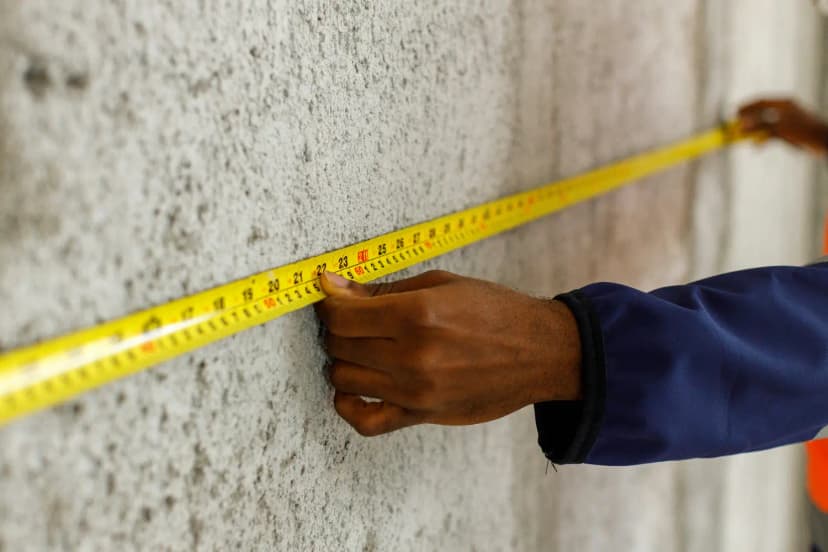
See gallery wall layouts with real sizes — 3, 5, 6, 8, 10+ frames. Match a Framky kit to your wall width, then hang with a 1:1 template.
Give it a try?
See how it works