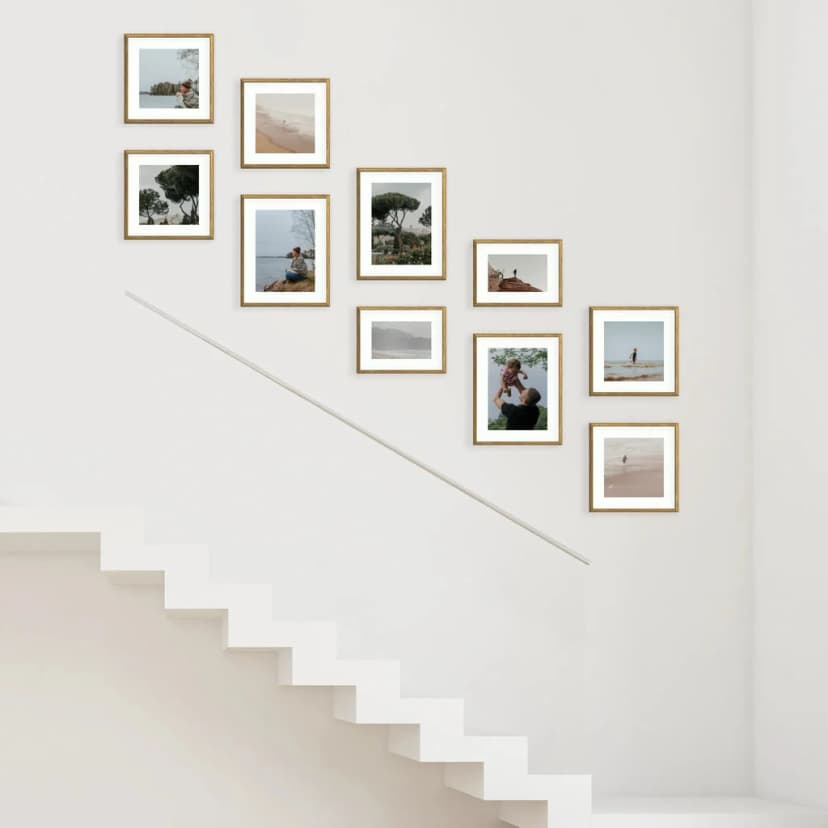
How to Hang a Photo Gallery Wall on Stairs
Hang a staircase photo gallery in about 15 minutes: measure the rise, pick a stepped layout, use Framky’s 1:1 template — no drill.
5 min read
Article
Large photos on the wall — how to match format and number of frames to wall width. Format table up to 70 × 55 cm, the 60–75% rule and print quality needs.
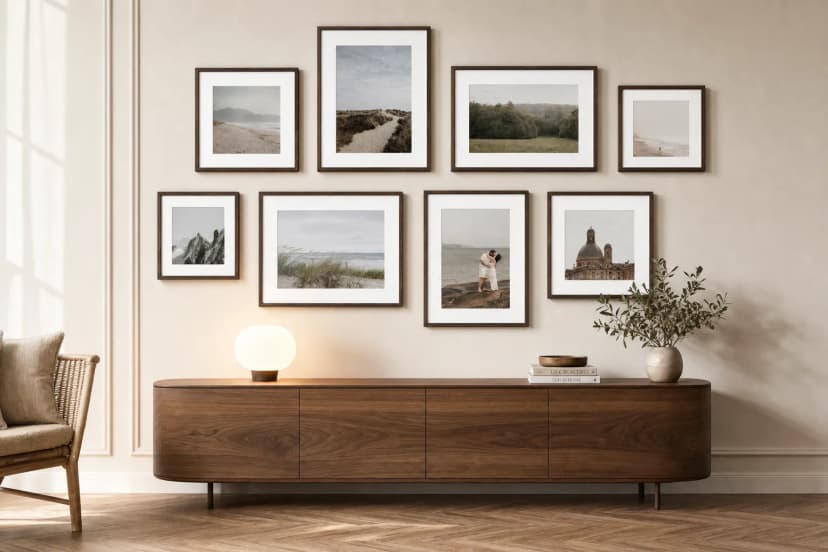
Short answer: Large photos on the wall mean larger frame formats — at Framky from 40 × 50 cm up to 70 × 55 cm (the largest format available; 70 cm on the longer edge). You match the format and the number of frames to the width of the wall, not to the number of photos: the composition should occupy 60–75% of the free wall's width. On a 200 cm wall that's a composition of 120–150 cm — e.g. one 50 × 70 cm frame or two side by side. For a wide wall you don't print one enormous canvas; instead you combine several larger frames into a gallery. The bigger the format, the more important the resolution: for 50 × 70 cm aim for about 4,000 px on the longer edge. A large photo forgives fewer mistakes — what counts is file quality and proportion to the wall, not "size for its own sake".
Large photos on the wall make the biggest impression of any form of decoration — but they're also the least forgiving. A format that's too small on a wide wall looks meagre, one that's too large overwhelms, and a low-resolution photo in a large format will show pixels and blur from a few steps away.
An important point to start with: "large" doesn't mean "infinitely big". The largest single-frame format at Framky is 70 × 55 cm (or 55 × 70 cm in portrait). When you want to fill a really large wall, the solution isn't one gigantic print but a gallery of several larger formats put together into a coherent composition — like in the photo above.
This guide breaks the decision down into two questions: which format and how many. You'll get a table matching format to wall width, a proportion rule, a print size calculator, and a short explanation of what resolution you need for a large print to be sharp.
The most common mistake with large photos is choosing the format "by eye" in the shop rather than for a specific wall at home. Yet the same 50 × 70 cm format looks impressive above a narrow sideboard and disappears on a wall four metres wide.
The starting point is the width of the free wall (or the piece of furniture you're hanging above). The table below gives the recommended format and number of frames for typical widths — with an upper limit on a single format of 70 × 55 cm.
| Wall width | Recommended solution | Number of frames |
|---|---|---|
| up to 120 cm | 40 × 50 or 40 × 60 cm | 1 |
| 120–180 cm | 50 × 70 cm (or 55 × 70 cm) | 1 |
| 180–240 cm | 50 × 70 / 70 × 55 cm, possibly a pair | 1–2 |
| 240–320 cm | two 50 × 70 cm frames or a mini-gallery of larger formats | 2–4 |
| over 320 cm | a gallery of 6–8 larger frames (formats up to 70 × 55 cm) | 6–8 |
The numbers are a starting point, not a rigid rule — if there's a tall piece of furniture against the wall or a lamp hanging down, adjust the composition to the real free space.
The simplest compositional rule for large photos is this: the composition should occupy 60–75% of the free wall's width (or the width of the furniture beneath it). It's the range in which the photos are present enough, but the wall still "breathes".
Examples in numbers:
Below 60% the photos look like stamps on an empty wall; above 75% the composition starts to overwhelm and loses the "frame" of empty space that sets it apart.
The second question after format is the number of frames — and here it's worth flipping your intuition. With a lot of photos, it's tempting to hang many small ones. But for a modern, strong effect less is more: one 50 × 70 cm frame makes a bigger impression than six small frames scattered across the wall.
When the wall is wide (over 240 cm), don't enlarge a single frame endlessly — because the largest format is 70 × 55 cm. Instead, put together several larger formats into a gallery: 4–8 frames (e.g. a mix of 50 × 50, 50 × 70 and 70 × 55 cm) forming one composition. That's how the layout in the photo above works — eight larger frames with a combined width of nearly 270 cm, which fill the wall more powerfully than any single print could.
Keep the gallery in a consistent frame colour and with an even spacing of 5–8 cm, so it forms one whole rather than a collection of separate pictures. If you have lots of photos you want to surround yourself with, we describe the rules of a classic gallery in the article how many photos in a wall gallery — sizes and proportions.
For a small format, resolution is rarely a problem. For a large one it becomes crucial: the same file that looks great at 21 × 30 cm can be noticeably soft and pixelated at 70 × 55 cm.
Rule of thumb: for a sharp print, aim for about 4,000 px on the longer edge for the 50 × 70 cm format and about 4,500 px for 70 × 55 cm. That corresponds to a density of around 150 DPI for large formats viewed from a distance — perfectly sufficient, because large photos are looked at from a few steps away, not from 30 cm.
The easiest way to check this is with a calculator — enter your file's dimensions in pixels and see which format it's suitable for without loss of quality.
Check in 3 seconds whether your photo suits the size you want.
Your photos never leave the browser.
Drag a photo here or pick one from your device
JPEG, PNG or WebP. Max 25 MB.
You'll find a full explanation of the relationship between pixels, DPI and print size in the article DPI in photo printing — how much you need.
A large format forgives not only low resolution but also poor printing. Flat colours, banding on gradients or a lack of depth in shadows are invisible on a small print but jump out on a large one.
That's why we print large photos using pigment printing with a set of 12 inks (12 means the number of inks in the printer, giving maximum colour-gamut coverage) on matte photographic paper, mounted on a rigid cardboard plate. The matte surface combined with a frame without glass eliminates light reflections — a large photo doesn't reflect the window or a lamp, which over a large surface would be particularly irritating.
The consequence of having no glass concerns location: don't hang large frames without glass in places exposed to water splashes or within reach of small children. Otherwise it's the ideal solution for a living room or bedroom.
Format and quality aren't everything — a large photo hung too high spoils the whole effect. The gallery standard: the centre of the composition at about 145–150 cm from the floor, roughly at the eye level of a standing person.
When hanging above a sofa, the lower edge of the frame should be about 15–25 cm above the backrest — then the photo and the furniture form a visual whole. You'll hold lightweight MDF frames on self-adhesive hangers (included), without drilling; they won't damage the wall, provided the paint is firmly bonded to the plaster and the plaster is stable. For the largest formats there's a traditional option: 2 nails in the inner corners of the frame (nails not included).
For a living room above a sofa, the 50 × 70 cm or 70 × 55 cm format usually works best (the latter is the largest single-frame format available). Choose it so that the composition occupies 60–75% of the wall's or the furniture's width. For a typical 200 cm wall that means one 70 × 55 cm frame or two 50 × 70 cm side by side.
The largest single-frame format at Framky is 70 × 55 cm (landscape) or 55 × 70 cm (portrait) — 70 cm on the longer edge. We don't print single prints larger than this format. To fill a wider wall, you combine several larger frames into one gallery.
On a wall up to 180 cm, usually one larger frame; on 180–240 cm, one or two; and over 240 cm, a gallery of 4–8 larger formats. Keep them all in the same frame colour, with an even spacing of 5–8 cm, so they form one coherent composition rather than a collection of separate pictures.
Aim for about 4,000 px on the file's longer edge. That's enough for a sharp 50 × 70 cm print viewed from a natural distance of a few steps. For 70 × 55 cm you need about 4,500 px. The easiest way to check this is with a print size calculator, by entering your photo's dimensions in pixels.
Often yes — modern smartphones take photos at a resolution of 4,000 px and more on the longer edge, which is enough for a 50 × 70 cm format. The problem is sometimes photos from digital zoom, heavily cropped shots, or frames grabbed from video recordings. Always check the file's dimensions in pixels before ordering a large format.
One larger frame (up to 70 × 55 cm) gives a strong, modern effect and is easier to plan. A gallery of several larger formats tells a story better and fills a wide wall that you can't close with a single print. If you're after minimalism and the power of a single frame — choose one large format; if you're after a full, rich wall — go for a gallery.
The centre of the photo (or of the whole gallery) should be at about 145–150 cm from the floor, that is, at eye level. When hanging above a sofa, leave 15–25 cm between the lower edge of the frame and the backrest, so the photo and the furniture form a visual whole.
If you're torn between one larger frame and a gallery of several formats, read how many photos in a wall gallery — sizes and proportions. Before ordering a large format, make sure about resolution in the article DPI in photo printing — how much you need. For more on why large photos look best without glass, see the quality without glass section.
You can order a large photo or a gallery of larger formats — with pigment printing on matte photographic paper and MDF frames without glass — on the photo frames listing, or design it as a whole in the Framky configurator.
Sign up and we'll send you a code with a bigger discount than the shop offers — plus occasional inspiration for your photo gallery wall.
Hang a staircase photo gallery in about 15 minutes: measure the rise, pick a stepped layout, use Framky’s 1:1 template — no drill.
Hang a photo wall in the stairwell: measure the rise, pick a layout along the banister, use a 1:1 template. No drill, about 15 minutes.
See gallery wall layouts with real sizes — 3, 5, 6, 8, 10+ frames. Match a Framky kit to your wall width, then hang with a 1:1 template.
Give it a try?
See how it works