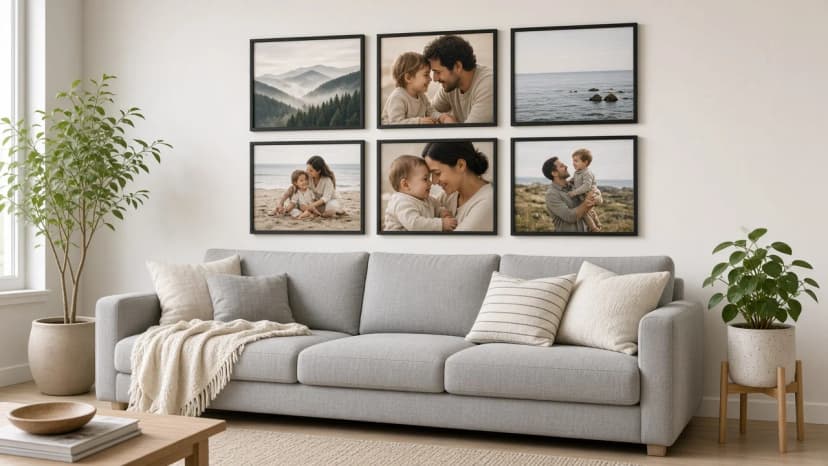
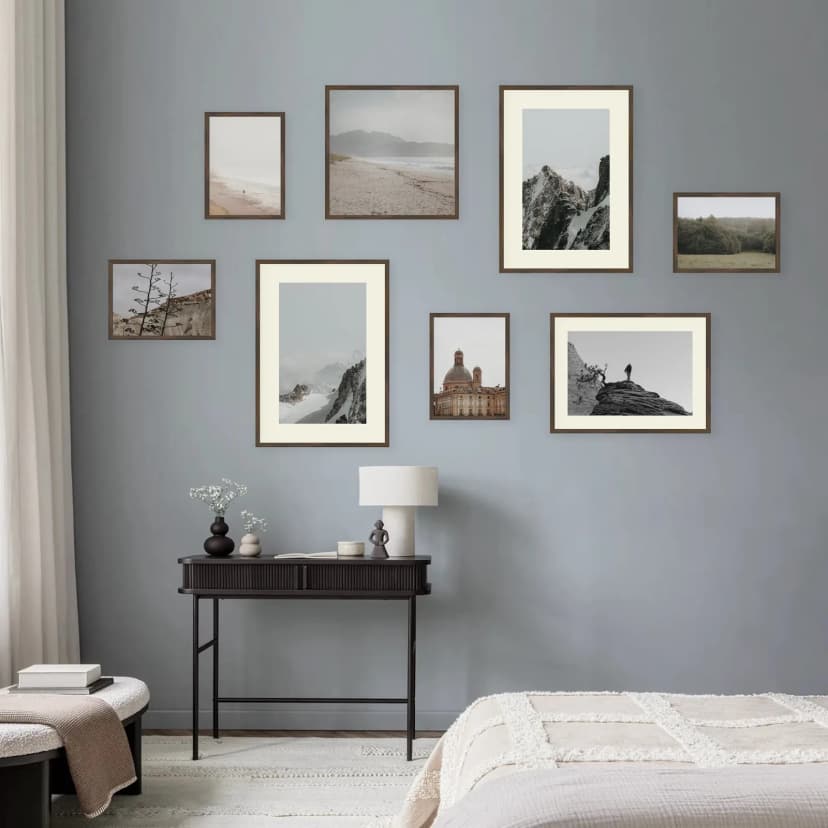
Can you hang picture frames with photographs in the kitchen? Safe and risky zones, distances from steam and grease, cleaning and common mistakes.
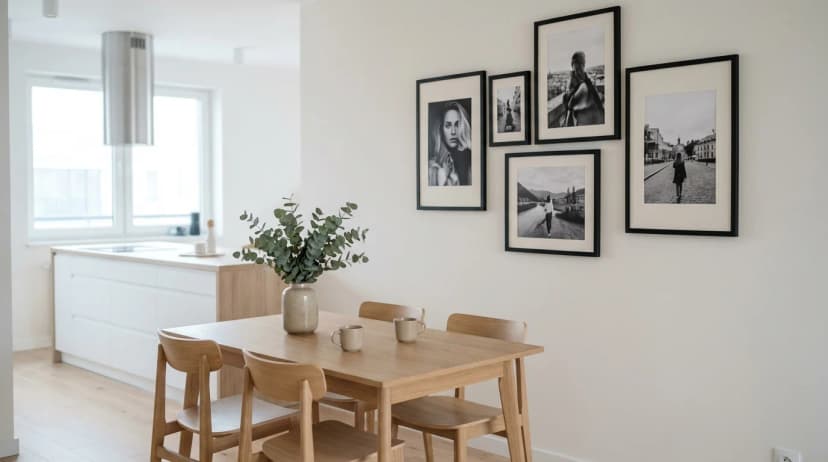
Short answer: You can hang photographs in a kitchen if you maintain a minimum distance of 60 cm from a source of steam (sink, kettle) and 80 cm from a source of grease (hob, extractor hood). The safest zone is the wall above the dining table or in the "living area" of an open-plan kitchen. Framky frames without glass will last 5+ years in a kitchen provided you have good ventilation and humidity below 60% RH.
The kitchen is one of the most challenging rooms for a photo gallery wall — and simultaneously one of the most beautiful places where such photographs can live. This is where families spend the most time together, so this is where photographs from the most important moments are seen most frequently. The trick is to choose a location that functions as a kitchen, but is not in the "war zone" of steam, grease and water.
What is a safe zone for MDF frames in the kitchen?
A safe zone for MDF frames is a section of kitchen wall at least 60 cm away from steam sources and 80 cm away from grease sources, with air humidity below 60% RH and no direct contact with water. In this zone, Framky MDF frames without glass maintain full durability for many years, and matte photographic paper does not become dull or warp.
Table: kitchen zones from safest to most risky
The table is based on three variables: humidity (steam), grease (aerosols from cooking) and splashing risk (water).
| Kitchen zone | Distance from risk source | Steam | Grease | Splashing | Safe |
|---|
| Wall above dining table | > 150 cm from hob | Low | Low | None | Yes |
| "Living area" in open-plan kitchen | > 200 cm from hob | None | Low | None | Yes |
| Wall along passageway, away from hob | 100–150 cm from hob | Low | Medium | None | Yes |
| Wall above or beside fridge | 80–120 cm from hob | Medium | Medium | None | Conditional |
| Wall 50–80 cm from sink | < 80 cm from sink | Medium | Low | Medium | Conditional |
| Wall < 80 cm from hob | < 80 cm from hob | High | High | Low | No |
| Wall above sink | 0–50 cm from sink | High | Medium | High | No |
| Extractor hood area | 0–60 cm from hood | Very high | Very high | None | No |
Key principle: Two dimensions really matter for frame durability in the kitchen: distance from the hob and extractor hood performance. A good cooker hood with external ducting can reduce risk by 80% compared with a recirculating hood.
Where to hang photos in the kitchen: 3 recommended locations
Location 1: Wall above the dining table
The safest choice. The dining table typically sits 2–3 metres from the hob, far from the sink and hood. A gallery of 3–6 frames in a horizontal arrangement above the table acts as a natural focal point and is viewed most often during meals.
Recommendation: 4 frames 30 × 40 cm in a single row, centred at 145–155 cm from the floor.
Location 2: "Living area" of an open-plan kitchen
Open-plan kitchens are increasingly common in UK homes. The wall in the living section (e.g. above a sofa or dresser) is practically safe from the cooking zone if it has a minimum gap of 250 cm.
Recommendation: gallery of 5–7 frames above the sofa, just as you would in a normal lounge. See How many photos in a wall gallery for exact dimensions.
Location 3: Wall along a passageway (kitchen corridor)
A narrow wall between the worktop and window or between the fridge and doorway to another room. It is safe if it lies outside the 80 cm zone from the hob.
Recommendation: linear gallery of 3–5 smaller frames (20 × 30 cm), vertically or horizontally.
Three places where NOT to hang photos in the kitchen
- Directly above the hob or extractor hood — temperature, steam, grease aerosols. Photographic paper yellows within 6–12 months, MDF profiles can warp.
- Above the sink or within 50 cm of the sink — water splashing, increased humidity. Individual drops are inevitable, and matte photographic paper is not waterproof.
- In a kitchen without an extractor hood — if your kitchen is closed and has no hood (or only a recirculating hood with carbon), humidity after cooking soup can exceed 80% RH for 30+ minutes. This is damaging to photographic paper long-term.
Do MDF frames last in a kitchen?
Yes, if they are in a safe zone. Medium-density MDF used in Framky frames has moisture resistance typical of kitchen furniture — it is not moisture-resistant MDF (V100), but under normal kitchen conditions with good ventilation it does not swell or warp. Temperature and humidity are key:
- Comfort temperature: 18–24 °C (typical domestic kitchen)
- Comfort humidity: 40–60% RH (below 60% MDF is stable for years)
- Critical humidity: > 70% RH for > 4 hours daily (damage in 1–2 years)
In practice: if your kitchen windows do not steam up in the morning after cooking dinner, your humidity is in a safe range.
How to clean frames in the kitchen
The kitchen produces a fine layer of aerosol that settles on every surface over time — including on frames. Cleaning every 1–2 months:
- Dry microfibre cloth — wipe the frame profiles without using water. Microfibre collects dust and light grease.
- Slightly damp microfibre cloth (every 3–6 months) — dampen the cloth in lukewarm water with a drop of washing-up liquid, wring it out well, wipe the profiles. Do NOT clean the photograph itself with a wet cloth.
- Never use alcohol, ammonia-based cleaners, vinegar at concentrations > 5%. These can damage the matte finish of the MDF profile.
- Clean directionally — always move the cloth along the frame edge, not across the photograph.
Gallery in the kitchen and interior style
The kitchen has its own aesthetic — clean, functional, often with lots of white surfaces. A photo gallery in the kitchen works best when:
- The subject matter is "domestic" — family at the table, shared meals, holidays. Studio portraits or abstracts work less well here.
- Frames are uniform — in a kitchen "full of elements" (appliances, pans, accessories) a gallery with mismatched frames becomes visual noise. Choose one colour and one profile.
- The number of frames is moderate — 3–6 frames maximum. The kitchen is not the place for a 12-frame museum gallery.
When a gallery in the kitchen will not work
- Small kitchen without a dining table (< 6 m², typical studio flat) — there is no wall far enough from the hob. Better to hang photos in the hallway or lounge.
- Kitchen without an extractor hood or with very weak ventilation — humidity from cooking lingers for a long time.
- Kitchen with large south-facing windows — strong UV (especially in summer) fades colours on photographic paper within 12–24 months, regardless of zone.
FAQ — questions users ask
Do MDF frames swell from steam in the kitchen?
Under normal conditions (humidity < 60% RH, good hood) MDF used in Framky frames does not swell. Risk appears at constant humidity > 70% RH or direct steam contact (less than 60 cm from a kettle or pan). In a safe kitchen zone, frames last 5+ years without warping.
Where should I hang photos in a small kitchen?
In a kitchen smaller than 8 m² it is safest to avoid working walls and choose the wall above the dining table (if the table fits in the kitchen) or the wall near the entrance. If no wall meets the 80 cm criterion from the hob, move the gallery to the hallway leading to the kitchen.
Do photos in the kitchen yellow?
Yes, but only in three specific conditions: direct UV light from a south-facing window (12–24 months to visible yellowing), grease aerosols from cooking without a hood (24–36 months), very poor print quality (non-pigment paper). Pigment printing with a set of 12 inks used by Framky is resistant to yellowing much longer than domestic inkjet printing.
What should I use to clean frames in the kitchen?
Dry microfibre cloth once a month. Slightly damp microfibre cloth (water with a drop of washing-up liquid, well wrung out) every 3–6 months to remove grease. Never use alcohol, ammonia, vinegar at > 5% concentration, or scouring products — these will damage the matte finish of the MDF profile.
Can I hang photos above the fridge?
Conditionally. The space above the fridge is dry, but at 80–120 cm from the hob it may be in a medium grease risk zone. If your hood works well and the fridge sits at least 1.5 m from the hob, you can hang 1–2 smaller frames (20 × 30 cm) there. A larger gallery in this spot is not a good choice.
Do photos in the kitchen need glass?
No. Protective glass in frames does NOT protect the photograph from steam or grease — there is always a gap between the frame and glass where moisture and grease seep through to the paper. In the kitchen, glass makes viewing difficult (reflections from lamps and windows) and increases frame weight, which is not ideal for self-adhesive hangers.
What next
Once you have selected a zone in your kitchen, it is worth reading How many photos in a wall gallery to choose the right number of frames for your available wall width, and How to align frames of different sizes if you are planning a mix of formats. If you are renting, check Photo gallery wall in rented accommodation — self-adhesive hangers are compatible with kitchen walls painted with emulsion.
Design a gallery suited to your safe kitchen zone in Framky's configurator — MDF frames without glass, pigment printing with a set of 12 inks, mounted on self-adhesive hangers.