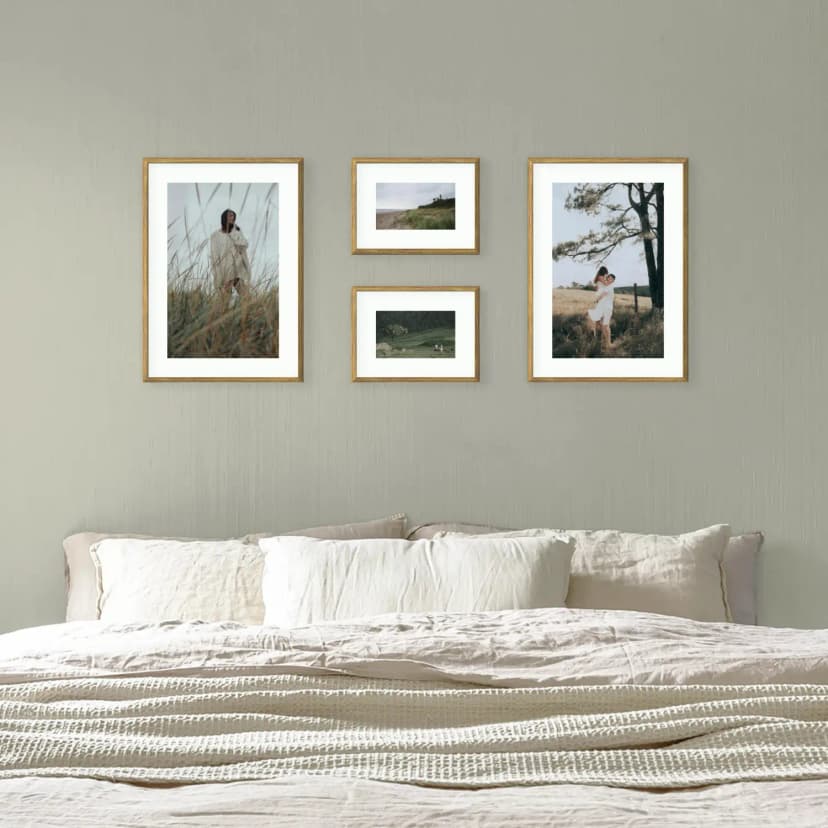
Gallery Wall on a Sloped Ceiling: How to Hang Pictures in an Attic Room
Under a sloped ceiling, hang the gallery on the low knee wall or the gable wall, not on the slope. Heights, layouts and fixings for attic rooms.
6 min read
Article
Living room wall decor — what to choose, the rules of composition and proportion, and the most common mistakes. A guide to restraint and timeless wall styling.
 in glass-free MDF frames in a living room — an example of timeless wall decor with restraint](/_next/image?url=%2Fblog%2Fwall-decor-living-room.webp&w=828&q=75)
Short answer: The best living room wall decor is whatever is coherent and proportional to the wall and the furniture — a photo gallery wall, a single large print, paintings, a mirror or decorative shelves. The key rule is "less is more": one dominant element works better than five weak ones. The decoration should occupy about 2/3 of the width of the furniture below the wall, and all the elements should share a common colour or theme. Coherence and proportion matter more than the number of decorations.
The living room is the showpiece of the home, and the wall is its largest empty surface. The temptation to "fill" it is strong, and that is exactly why the most common mistake is overloading. This article helps you choose living room wall decor sensibly: which types work, how to compose them, and where the line lies between "cosy" and "chaotic".
We focus on restraint and timelessness, because living room decoration isn't a shop window you change every season — it's the backdrop to your everyday life for years. At the end you'll find a comparison table of decor types and answers to the most common questions.
The choice is wide, but in practice a handful of types prove themselves. A photo gallery wall — a set of frames with printed photos as a coherent composition; the most personal option. A single large print — one large photo as a focal point. Paintings and reproductions — painting or graphics, elegant but often impersonal. A mirror — functional, enlarges the room. Decorative shelves — allow rearrangement, but are easy to overload. 3D décor and clocks — a complementary accent, rarely the wall's main character.
Each of these types can look good or bad — the difference comes not from the choice itself, but from the composition, the proportions and the coherence. That's what we turn to next.
The most important rule of living room decoration is counter-intuitive: the fewer the elements, the stronger the effect. A single large print or a coherent gallery of 5–7 frames makes a bigger impression than twenty trinkets scattered across the wall.
The reason is simple — the eye needs a point to settle on. An overloaded wall has no hierarchy, so the eye "slides" across it without stopping anywhere. Leave free space, "breathing room", around the decoration. It's what makes the decoration look intentional rather than accidental.
Two numbers order most decisions. Decoration width ≈ 2/3 of the furniture width below it. For a 220 cm sofa, the composition should be about 145–160 cm. The centre of the composition at a height of 145–150 cm off the floor — the eye level of a standing person.
A third rule concerns gaps: in a photo gallery, keep an equal 5–8 cm gap between frames. These three values eliminate 90% of proportion problems. There's more on aligning frames of different sizes in how to align frames of different sizes on a wall.
| Type of decor | Effect | Risk of overloading | Durability / timelessness | Who it's for |
|---|---|---|---|---|
| Photo gallery wall | Personal, coherent | Low (if one frame colour) | Very high | Anyone with their own photos |
| A single large print | Minimalist, strong | Very low | High | Modern interiors |
| Paintings and reproductions | Elegant, artistic | Medium | High (originals) | Art lovers |
| Mirror | Functional, optical | Low | High | Small living rooms |
| Decorative shelves | Changeable, "alive" | High | Medium | Those who like frequent changes |
| 3D décor / clocks | Accent | High | Medium | As a complement |
Overloading. The most common and most dangerous mistake. Too many elements rob the wall of hierarchy and make it look messy. The remedy: remove half and keep only what really means something.
Poor proportions. Decor that's too small on a large wall looks lost; too large overwhelms. Stick to the rule of 2/3 of the furniture width and a centre height of 145–150 cm.
Lack of coherence. Frames in five different colours, photos one moment in sepia and the next in vivid colour, a poster in a completely different style beside them — that's a recipe for chaos. Choose one frame colour and one photo tone. You can read about colour consistency in colour consistency in a gallery.
A photo gallery wall solves all three problems at once. You achieve coherence through one frame colour and one photo tone. You control proportions by matching the number and sizes of frames to the wall. And the timelessness comes from the fact that your own photos never go out of fashion — unlike a trendy poster or a seasonal trend.
At Framky a gallery means MDF frames (not wood) in black, white, dark oak, light oak, brushed gold and brushed silver. The frames are without glass, so they eliminate light reflections — the photos look deep and clear from every angle of the living room. Pigment printing with a set of 12 inks on matte photographic paper keeps the colours faithful for years, and a rigid cardboard plate keeps the print flat. We have over 1,000 ready-made layouts and a rating of 4.8/5 on Trustpilot.
You hang the gallery on self-adhesive hangers (included), with no drilling — they won't damage the wall, provided the paint is firmly bonded to the plaster and the plaster itself is stable. Optionally, each frame can be hung on 2 nails in the inner corners (nails not included). Because the frames are without glass, don't hang them where they're exposed to water splashes or within reach of small children.
The decoration has to talk to the rest of the interior. In a modern living room a minimalist gallery of 3–4 large frames in black or white works well. In a Scandinavian one — black-and-white photos in light frames. In a classic one — a symmetrical gallery in matching frames, possibly with mouldings behind it. In boho — warmer tones and a mix of textures.
A photo gallery has the advantage over other decorations that you can match it to any style simply by choosing the frame colour and the photo tone — without buying new objects. There's more on choosing frames in how to choose wall frames.
The safest and most personal choice is a photo gallery wall or a single large print. Paintings, a mirror and decorative shelves work too, but a gallery combines a visual effect with the emotional charge of your own photos. The key is coherence and proportion, not the type of decoration itself.
Stick to the "less is more" rule: one dominant element plus, at most, one complementary one. Leave free space around the decoration. It's better to hang less but coherently than to fill the wall with random objects in different styles.
A decoration above furniture should be about 2/3 of its width, and the centre of the composition should sit at a height of 145–150 cm off the floor. In a photo gallery, keep an equal 5–8 cm gap between frames. These three numbers solve most proportion problems.
Yes — especially in the form of a minimalist gallery of a few large frames or a single large print. Black or white frames and a muted, coherent photo tone suit a modern interior best. The absence of glass in Framky frames further underlines the modern, matte character.
The most versatile are black and white frames — they suit any style and don't date along with trends. Dark and light oak go well with Scandinavian and natural styles. More important than the colour is that all the frames in the gallery are one colour — that guarantees coherence.
Usually one strong focal point on the main wall is enough. On a very long wall (over 4 m) you can carve out two zones, e.g. a gallery above the sofa and an additional accent beside it. Avoid scattering attention with lots of small decorations on every wall of the room.
For choosing specific frames, turn to how to choose wall frames, and for a broader overview of options — to living room wall ideas. If you're starting from scratch, how to decorate an empty wall will walk you through step by step. You can read about photo colour consistency in colour consistency in a gallery.
You can design a coherent, timeless photo gallery — with glass-free MDF frames and no-drill mounting — in the Framky configurator.
Sign up and we'll send you a code with a bigger discount than the shop offers — plus occasional inspiration for your photo gallery wall.
Under a sloped ceiling, hang the gallery on the low knee wall or the gable wall, not on the slope. Heights, layouts and fixings for attic rooms.
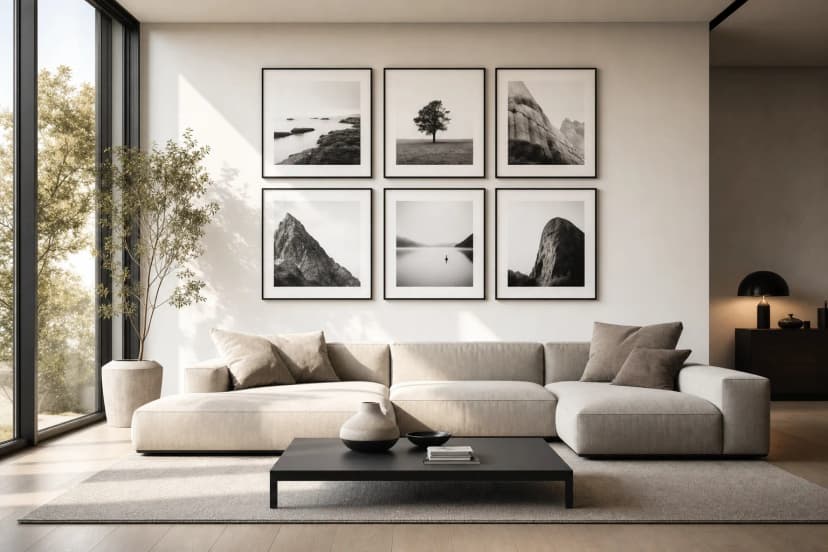
Treat the TV as one frame: centre the gallery on the screen, align edges, keep equal gaps and use larger frames near it. Four layouts that work.
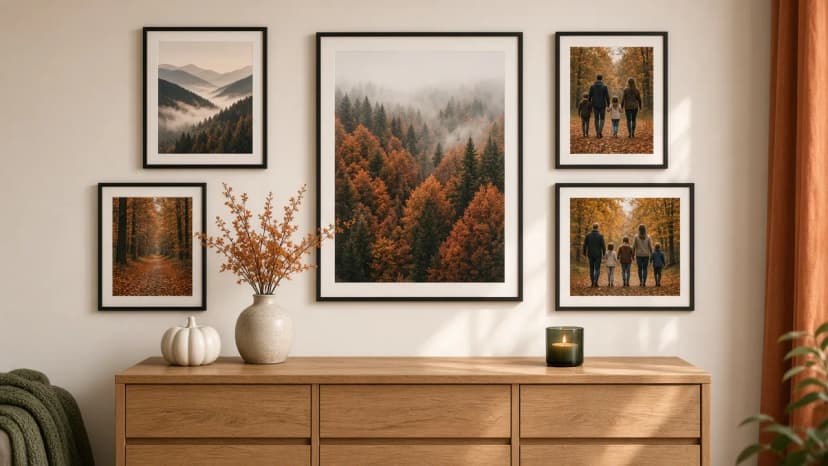
Autumn wall decorations without new frames: swap 2–3 photos in the gallery for forest, misty mountains, night sky and winter photographs from Framky Artists. How many to change, which palette, and when to return to the spring set.
Give it a try?
See how it works