Quick answer: Seasonal photo rotation refreshes your walls 2–4 times per year without new holes. Swapping one photo in a Framky frame takes an average of 90 seconds (based on Framky internal testing). Two practical schedules: (1) full rotation 2× yearly (summer/winter), (2) swap 1–2 photos 4× yearly. Store unused photos in acid-free archival cardboard boxes at 15–25 °C and below 60% RH.
One of the overlooked advantages of Framky's self-adhesive hangers is that your entire gallery is "modular" — each photo can be swapped in minutes without taking frames off the wall, drilling holes, or taking risks. This opens up a possibility many people don't consider: a gallery that evolves with the seasons, your holidays, and family moments. This article shows you how to make it a ritual, not a hassle.
What is seasonal photo gallery rotation?
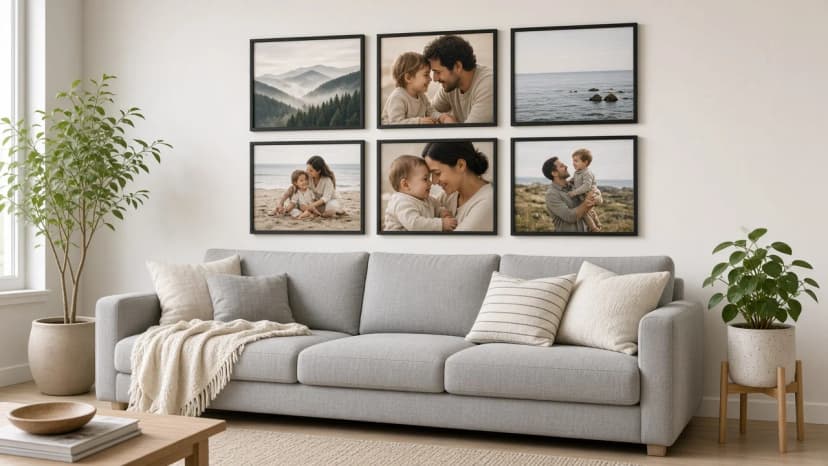
Seasonal photo rotation is the practice of systematically swapping photographs in your wall-hung photo gallery wall 2–4 times yearly, so the images match the current season, family events, or your interior mood. Unlike "casual swaps" (when you're bored with a photo), seasonal rotation is planned in advance and involves a full set of frames, not just one.
Two practical rotation schedules
Schedule 1: Full rotation 2× yearly (summer/winter)
Every 6 months, you swap all photos for a new set. Two collections: "summer" (holidays, sunshine, nature, bright tones) and "winter" (festive days, intimate interiors, warm light, snow, family gatherings).
Pros:
- Dramatic interior refresh twice yearly — like a "renovation" without cost.
- Simple logistics — 1–2 hours of work twice a year.
Cons:
- Requires 2× more photos than a standard gallery (for 6 frames, you need 12 images).
- Significant upfront printing cost (double the images).
Best for: families who love clear seasonal celebrations and photograph frequently.
Schedule 2: Partial rotation 4× yearly
Every 3 months, you swap 1–2 photos in your gallery (e.g., a "summer" frame, one "autumn", one "winter", one "spring"). Most of the gallery stays constant, only the "seasonal accent" changes.
Pros:
- Minimal effort (5–10 minutes once per quarter).
- Fewer photos to store (only 1–2 extra sets).
- Stable gallery "core" that builds interior identity.
Cons:
- Less dramatic change — visitors need to notice the single new photo.
Best for: busy families with limited time, more minimalist approach to decor.
Table: rotation schedules across the calendar year
| Month | Schedule 1 (2× yearly) | Schedule 2 (4× yearly) |
|---|
| March | — | Swap 1–2 photos for "spring" set |
| May | Full swap to summer set | — |
| June | — | Swap 1–2 photos for "summer" set |
| September | — | Swap 1–2 photos for "autumn" set |
| November | Full swap to winter set | — |
| December | — | Swap 1–2 photos for "festive" set |
Key principle: Your swap should have a calendar date — e.g. "15 May" and "15 November" (Schedule 1) or the first weekend of each quarter (Schedule 2). Without a fixed date, rotation "eventually happens", which means never.
Step by step: how to swap a photo in a Framky frame (90 seconds)
Process measured in our internal tests. Average time to swap one photo: 90 seconds.
- Remove frame from wall (optional) — Framky's self-adhesive hanger tolerates multiple remove/rehang cycles. You can swap photos while the frame stays on the wall.
- Turn frame back-side to you (or reach behind if leaving it mounted).
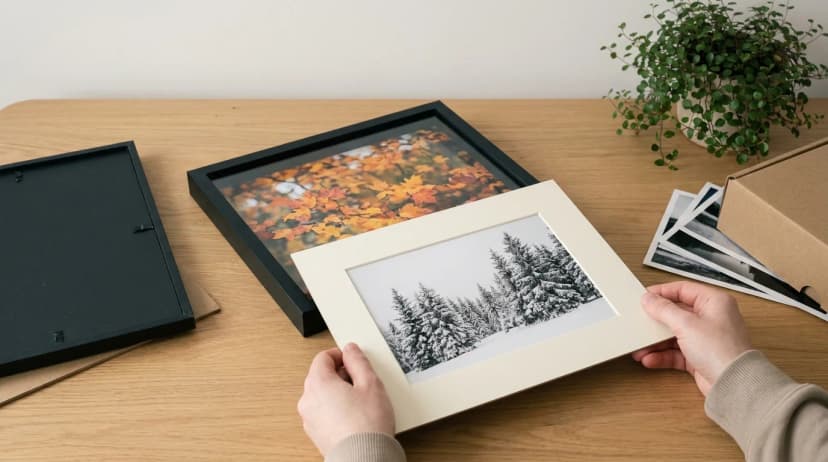
- Open the back — Framky frames have a rear panel held by metal clips. Turn the clips 90°, remove the panel.
- Remove current photo — the photograph sits loosely between the rigid cardboard plate and rear panel.
- Insert new photo — align with the frame edges, ensure no folds.
- Close rear panel and lock the clips.
- Rehang if removed.
Full process for 6 frames = 6 × 90 seconds + removal/rehang time = roughly 15–20 minutes total.
Which photos work best for each season
"Summer" photos (May–August)
- Holiday photos from beach, mountains, or abroad
- Family in garden, at barbecue
- Children in swim wear
- Flowers, green meadows
- Sunsets, beaches
Tone: bright, saturated, warm but not oversaturated.
"Autumn" photos (September–November)
- Forest in autumn colours
- Park walks with children
- First days back at school
- Family portraits in jumpers
- Coffee, books, indoor scenes
Tone: warm oranges and browns, muted saturation.
"Winter" photos (December–February)
- Snow, winter landscapes
- Festive occasions, Christmas Eve, family at table
- Fireplace glow, fairy lights
- Winter break, skiing, sledging
- Children in winter clothing
Tone: cool whites and blues + warm accents (fire, lights).
"Spring" photos (March–April)
- First flowers, blossoming trees
- Family in park
- Children with Easter eggs
- Bright, fresh mornings
- New green leaves after winter
Tone: bright, fresh, pastel.
How to store photos you're not using
Unused photos (waiting for the next season) need proper storage conditions. Poorly stored photographic paper loses colour even off the wall.
Optimal conditions:
- Temperature: 15–25 °C (not in basement, not in attic)
- Humidity: < 60% RH (not in bathroom, not in kitchen)
- Light: no direct sunlight
- Position: flat, not folded or rolled
Recommended containers:
- Acid-free archival cardboard boxes (available at stationery shops, cost £15–30)
- Large envelopes of heavy paper — for individual photos
- Photo filing boxes with folders — for organised collections
Not recommended:
- Plastic bags — condensation and vapours damage paper
- Plastic envelopes — same issues
- Regular supermarket cardboard boxes — often contain acids that fade photos over time
Two practical storage systems
System A: "Two shelves"
Two shelves in a cupboard or cabinet:
- "In use" shelf — current wall frames (empty if gallery is hanging)
- "Archive" shelf — unused photos in acid-free box, sorted by season
When swapping: remove current photos to archive, pull out next season.
System B: "Set in box"
Each seasonal photo set in its own labelled box: "Summer 2026", "Winter 2026/27", etc. Never mix sets. After a year, pull out "Summer 2025" box (no new printing needed) and the cycle repeats.
Advantage: over time you build an archive of seasonal sets from multiple years. Rarely need new prints — you already own most sets.
When seasonal rotation doesn't make sense
- If your gallery is a "timeline". Galleries showing a child's first year or wedding anniversary are by definition fixed — swapping breaks the narrative.
- If you don't photograph enough. Seasonal rotation requires a photo archive. If you shoot 5–10 times yearly, you lack enough images to rotate.
- If your family won't notice changes. Rotation only works if someone sees and appreciates the swap. If you're the only one looking at the wall — decide if the personal joy of changing it justifies the effort.
- If frames are permanently mounted (e.g. drilled into wall, traditional hanging). Then the "no new holes" advantage disappears — you already have holes. Rotation still works but loses its main benefit.
FAQ — questions users ask
How often should I change photos in my gallery?
Two practical schedules: (1) full rotation 2× yearly (summer and winter) for families wanting clear interior changes, (2) swap 1–2 photos 4× yearly (quarterly) for minimalists. We don't recommend more frequent swaps — the gallery doesn't have time to "settle" into your space, and the effort outweighs the benefit.
Where do I store photos I'm not using?
In acid-free archival cardboard boxes (available at stationery shops for £15–30) in a room with 15–25 °C temperature and below 60% RH humidity. Not in a basement (dampness), not in an attic (temperature swings), not in a bathroom (steam), not in plastic bags (condensation). A bedroom or study cupboard is ideal.
How long does it take to swap a photo in a Framky frame?
About 90 seconds per frame (based on Framky internal testing). For a 6-frame gallery: 15–20 minutes total with frame removal and rehang. If you swap photos without removing frames from the wall (reaching behind), time drops by 30–40%.
Can I frequently remove frames without damaging the self-adhesive hanger?
Framky's self-adhesive hangers are designed for one strong adhesion. After swapping a photo, you can leave the frame on the wall — the swap happens through the rear panel, so the hanger stays untouched. If you physically remove and re-stick the frame, the hanger's holding strength drops 30–40% with each cycle. Use this only when necessary.
Can I have different frame sizes in a seasonal rotation gallery?
Yes, but swapping becomes more complex. You must prepare photos in exact dimensions for each frame (20 × 30, 30 × 40, 40 × 50, 50 × 70 cm). We recommend 2:3 aspect ratio for most Framky sizes. Swapping 6 frames of different sizes takes 20–25 minutes (longer than uniform sets, as you must check each photo goes to the right frame).
How large a photo archive do I need?
For 2× yearly (full rotation): 2 sets of 6 photos = 12 images in circulation. For 4× yearly (partial rotation): 1 permanent gallery + 4 seasonal swaps = 10 images total. After several years, your archive naturally grows — in the "Set in box" system, you might have 5–10 sets from recent years, and you rotate between them without reprinting.
What's next
If you're planning your first gallery and want it "rotation-ready", start with How to plan a photo gallery wall step by step. For choosing cohesive colours across seasonal sets, Gallery colour consistency is helpful. If you're rotating photos in a rental flat, remember self-adhesive hangers won't damage walls — details in Photo gallery wall in a rental flat.
Build a seasonal rotation gallery — with MDF frames and interchangeable photo inserts accessed from the rear panel — in the Framky configurator.