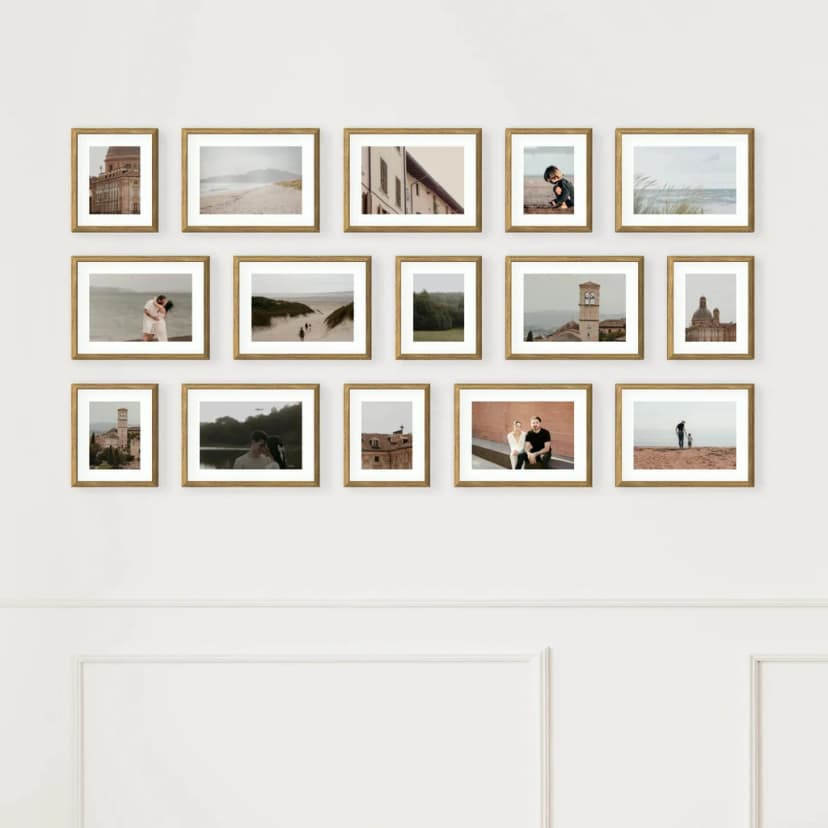
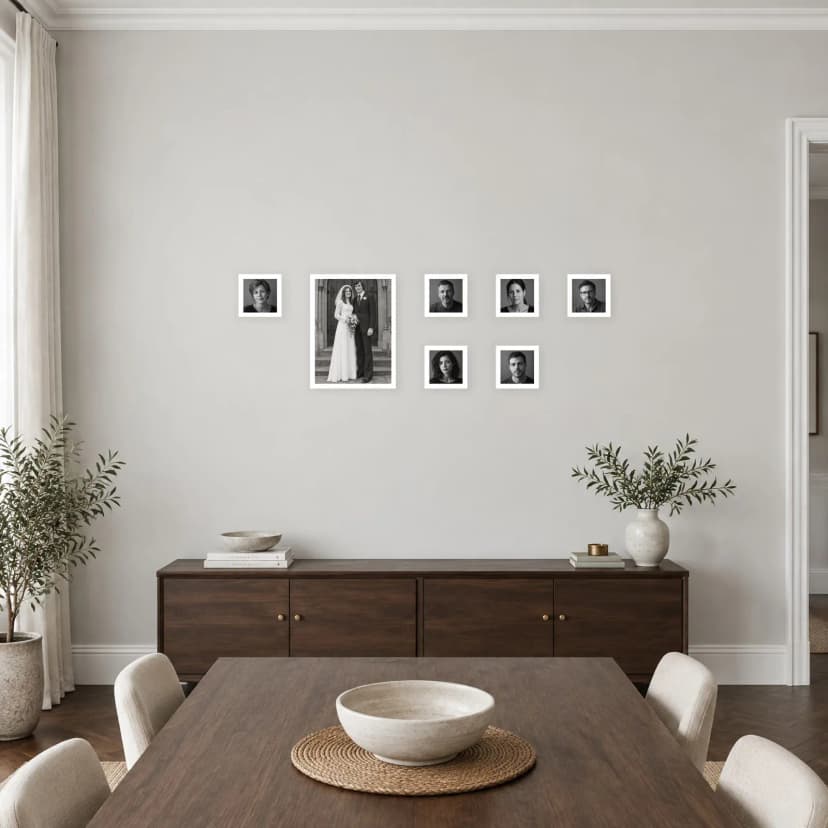
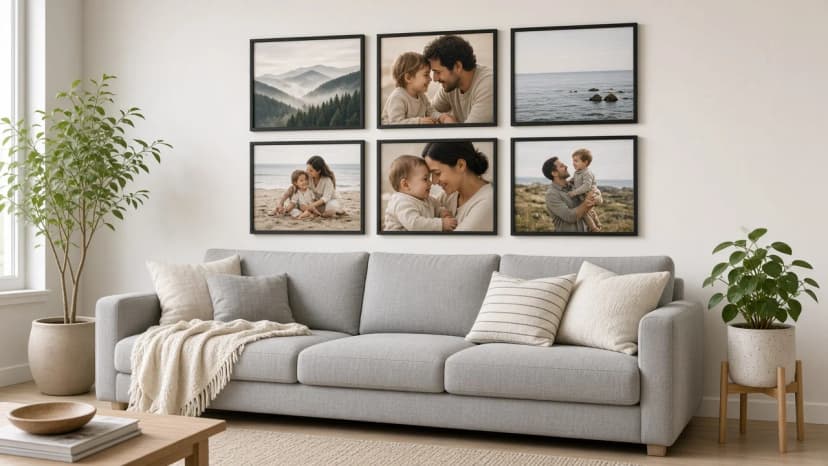
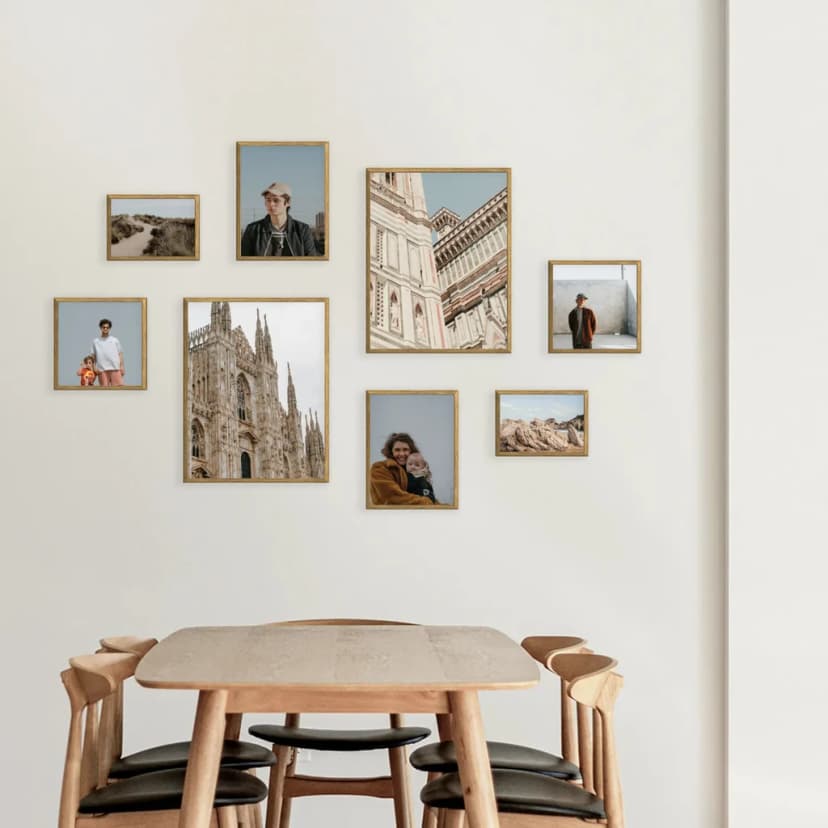
Short answer: A scatter gallery wall, also called a salon-style gallery wall, hangs mixed photo frames in a loose, irregular cluster instead of a grid. Gaps stay at 5–8 cm. A Framky kit such as Twilight Scatter L (8 frames, 251 × 135 cm) prints the layout on a 1:1 paper template, so you transfer scattered photo frames rather than placing them by eye.
A scatter gallery is a layout style, not a single product. The outline is uneven. Frame sizes mix. There is no shared centre line. That is the salon-style gallery wall people mean when they search for scattered photo frames: a cluster that looks collected, with the gaps still even enough that the wall reads as one set.
This page is about that style. Counted layouts for 3, 4, 5, 6, 8 or 9 frames live in picture frame arrangement ideas. Widths and heights of whole kits live in gallery wall layouts with sizes. Every kit below is a complete photo gallery wall: matched MDF frames, prints of your photos, a 1:1 paper template, and self-adhesive hangers.
Every size is the footprint of the whole set, not of one frame. Frame formats are width first in centimetres, so 50×30 is landscape and 30×40 is portrait.
Scatter vs grid vs collage
A grid, a collage, and a scatter gallery wall can all hold eight frames. They do not hang the same way.
Grid
Collage
Scatter / salon-style
Outline
rectangle or two even rows
closer to a block with a visual centre
irregular; the outer edge steps
Frames
one format, or one height per row
mixed formats around a centre
mixed formats, no shared axis
Gaps
identical, so a 1 cm slip shows
even, 5–8 cm
even, 5–8 cm — the looseness is the outline, not wild gaps
Photos
one crop, one session
mixed portrait and landscape
mixed; a few larger prints carry the wall
Reads as
one block
one composition
a salon wall of frames collected over time
A grid. Identical frames, identical gaps, a rectangular outline
The grid is the opposite of scatter. Geometric Office M is six 55×55 squares at 225 × 125 cm. Parallel Flow is a two-row grid. Use those when the photos share a crop.
A collage, such as Layered Moments L or Organic Flow L, mixes sizes but still sits as one block. Organic Flow has no centre line, which is why it sits next to scatter in the shop, but its outer edge is still a designed rectangle.
Salon-style scatter goes further. The cluster is allowed to step. Twilight Scatter is the kit built for that. The gaps are still 5–8 cm. “Scattered photo frames” does not mean random centimetres between them. The irregularity is the silhouette, not the spacing.
How many frames in a scatter gallery wall
Three frames rarely read as scatter. They read as a small group. Five is the lowest count that starts to look salon-style, if the sizes mix. Eight to ten is the count that fills a proper wall without turning into a grid.
Pick Twilight Scatter when you want the salon-style gallery wall. Pick Scatter L when the wall is wide and low: one 40×60 with two runs of 25×25 squares. Pick Organic Flow or Layered Moments when you want mixed sizes inside a tighter rectangle. Counted grids stay in the arrangement-ideas article.
Scatter. A linear scatter: one larger print and two runs of squares. L is 180 × 60 cm
Spacing for scattered photo frames
Keep 5–8 cm between frames. Closer looks cramped. Wider and the frames stop reading as one scatter gallery wall; they become separate pictures. That is the same rule as in the living-room guide and the layouts-with-sizes article.
Salon-style does not mean larger gaps. The looseness comes from mixed formats and an uneven outline. If you pull two frames 15 cm apart “to make it look scattered”, the wall stops being a gallery.
In a Framky kit you do not measure those gaps. They are printed on the 1:1 template.
How to plan a scatter gallery wall with a Framky template
A homemade scatter is hard because every frame has a different size and a different hanging point. The template removes that.
Measure the usable width and height. Write them as width × height, for example 260 × 140 cm. A 251 cm kit needs a wall at least that wide, with a little air at each side.
Pick the kit whose footprint fits both numbers. Twilight Scatter L and XL share a 251 cm width; XL adds 40 cm of height for two extra frames.
Tape the 1:1 paper template to the wall, level. Above a sofa, put the bottom edge 15–20 cm above the back cushions. The two-thirds sofa-width rule still holds: a 251 cm set wants a long wall, not a two-seater.
Mark the hanging points, take the paper down, and press each self-adhesive hanger on its mark for 30 seconds.
Hang the frames. The scatter is already right because it was right on the paper.
The self-adhesive hangers do not damage the wall if the paint is firmly bonded to the plaster and the plaster is stable. On peeling paint or weak plaster use 2 nails in the inner corners of each frame (nails not included). The full method is in hanging photo frames without drilling.
The frames are MDF frames without glass. The photos are made with pigment printing with a set of 12 inks on matte photographic paper, with a rigid cardboard plate behind the print.
If none of the footprints fits the rectangle you measured, build a custom salon-style layout in Framky Studio. Keep the 5–8 cm gaps while you move frames. Check the width and height of the design against the wall before you order.
Ready-made scatter and salon-style kits
Twilight Scatter is the kit named for this style. L is eight frames at 251 × 135 cm. XL is ten frames at 251 × 175 cm, same width, more height. Mixed 50×70, 30×40, squares and landscapes sit in a free cluster. Start here if you want a scatter gallery rather than a grid.
Scatter is a different shape with the same family name. Scatter L is 180 × 60 cm: one 40×60 and seven 25×25 squares in two runs. Use it on a long, low wall, a sideboard, or a dining stretch, not as a floor-to-ceiling salon.
Organic Flow, Layered Moments, Patchwork Tableau are the collages nearest to scatter. They mix sizes. They keep a tighter outer rectangle. They are the right next step if Twilight Scatter is too wide for the wall.
Centerpiece Flow L is five frames at 144 × 94 cm around one 50×70. It is a small loose layout, useful where eight frames will not fit.
What is a scatter gallery wall?
A scatter gallery wall is a salon-style layout: mixed photo frames in a loose, irregular cluster rather than a grid. Gaps stay at 5–8 cm. The outline steps. Framky kits such as Twilight Scatter L (8 frames, 251 × 135 cm) and Twilight Scatter XL (10 frames, 251 × 175 cm) are built for that shape.
How is a salon-style gallery wall different from a grid?
A grid uses one format and identical gaps, so it reads as one block. A salon-style gallery wall mixes formats and lets the outer edge step. Geometric Office M is a grid of six 55×55 squares at 225 × 125 cm. Twilight Scatter L is eight mixed frames at 251 × 135 cm. Do not hang scatter photo frames as a homemade 2×4 unless you can hold a 5–8 cm gap on every side.
How many frames in a scatter gallery wall?
Five is the lowest count that starts to look salon-style. Eight to ten fills a wall. Three frames look like a small group, not a scatter. Twilight Scatter is 8 or 10. Scatter L is 8 in a low strip. Centerpiece Flow L is 5 around one hero print.
How much space should I leave between scattered photo frames?
5–8 cm. The scatter is in the silhouette and the mix of sizes, not in wider gaps. In a Framky kit the gaps are fixed on the 1:1 template, so you transfer them instead of measuring them.
How do I plan a scatter gallery wall with a Framky template?
Measure the wall as width × height. Pick a kit whose footprint fits, for example Twilight Scatter L at 251 × 135 cm. Tape the 1:1 paper template, mark the hangers, peel it off, and hang. The self-adhesive hangers hold if the paint is firmly bonded to the plaster and the plaster is stable.
Framky Artists is a catalogue of photographs by independent photographers. Filter by category, colour or place, mix them with your own and order a gallery in frames without glass.
The AI editor in Framky fixes a photo from one sentence: it removes people from the background, opens closed eyes, smooths wrinkles and blurs the background. See how the preview, the final version and credits work.
 of mixed MDF frames without glass on a living-room wall](/_next/image?url=%2Fblog%2Fscatter-gallery-wall%2Ftwilight-scatter-l.webp&w=828&q=75)