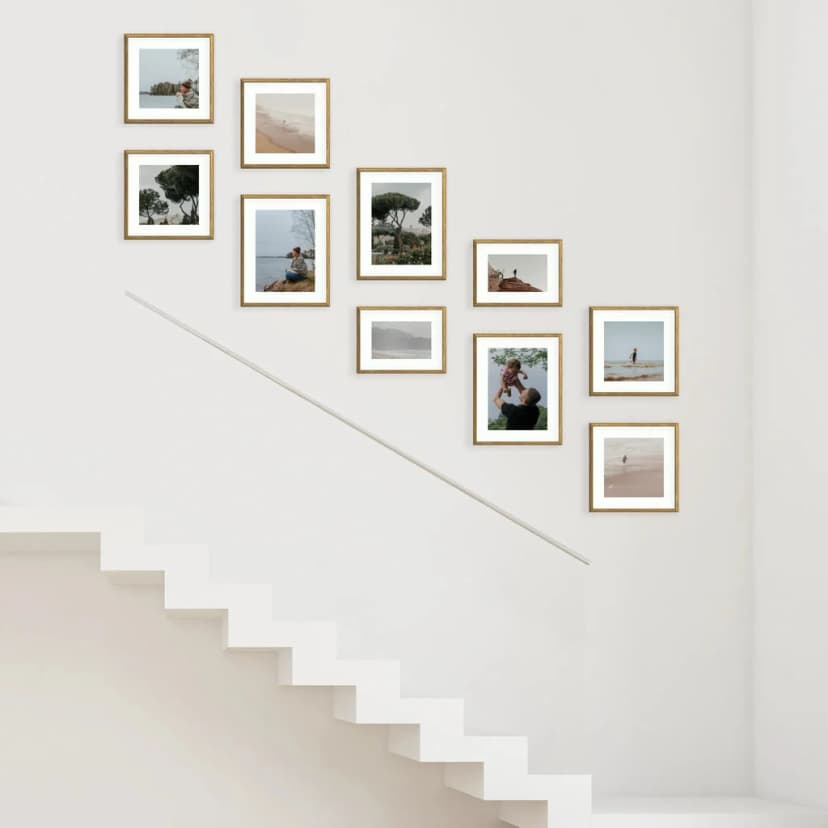
How to Hang a Photo Gallery Wall on Stairs
Hang a staircase photo gallery in about 15 minutes: measure the rise, pick a stepped layout, use Framky’s 1:1 template — no drill.
5 min read
Article
What to hang above the sofa — clear rules for proportion and height plus 4 proven ideas for the wall behind your couch. A practical guide with real numbers.
 of MDF frames without glass hung symmetrically above a light sofa in a living room — an example of decorating the wall behind a couch](/_next/image?url=%2Fblog%2Fabove-sofa-wall-v2.webp&w=828&q=75)
Short answer: Above the sofa, the best thing to hang is a composition roughly two-thirds the width of the sofa. Place the bottom edge of the decor 15–25 cm above the backrest, and the centre of the whole composition at eye level — around 145–150 cm from the floor. The four proven options are: a photo gallery wall, one large frame, a triptych or diptych, and a collage. Decor above the sofa should "talk" to the furniture — match its width to the couch and its height to a seated person, not a standing one.
The wall behind the sofa is usually the largest, most visible surface in the living room — and the one that stays empty the longest. The problem isn't a lack of ideas; it's proportion: frames that are too small get lost above a wide sofa, while a picture hung too high "floats off" from the furniture and hangs in a void.
In this article we give you specific numbers (width, height, spacing) and four layouts that work well above a sofa in real homes. No vague advice like "pick something that suits you".
The most important rule is this: decor above the sofa should be about two-thirds the width of the sofa itself. For a 220 cm sofa, that means a composition around 145–150 cm wide. A composition narrower than half the width of the furniture looks "lost", while one wider than the furniture itself overwhelms.
The second rule concerns the height of the bottom edge: it should sit 15–25 cm above the backrest of the sofa. This lets the decor and the furniture read as a single unit rather than two separate elements. Leave a gap larger than 30 cm and the composition "floats off" from the sofa.
The classic gallery rule says the centre of the composition should be at eye level — around 145–150 cm from the floor. Above a sofa it's worth tweaking slightly: most of the time you look at this wall from a seated position, so lowering the centre by a few centimetres (to around 140 cm) is often more comfortable.
In practice, just hold to two reference points at once: a bottom edge 15–25 cm above the backrest and a composition centre around 140–150 cm from the floor. With a standard sofa, those two conditions almost always reconcile. There's more on alignment itself in How to align frames of different sizes on the wall.
Below are the four most popular layouts above a sofa — each suits a different situation.
A set of several frames (usually 5–9) forming a cohesive composition. The most flexible option: it fills a wide wall, tells a story and lets you mix formats. A photo gallery wall works brilliantly above a sofa because its width is easy to match to the furniture. You can also swap it out seasonally without drilling again.
A single large frame (e.g. 70 × 100 cm or bigger) with one strong photo. It works in minimalist and modern interiors where a single focal point matters. It demands a genuinely high-quality photo — at a large format, resolution counts (see DPI in photo printing).
Two (diptych) or three (triptych) frames forming a single horizontal line. It's a natural choice above a sofa — a horizontal layout follows the shape of the furniture perfectly. It works wonderfully with panoramas (mountains, the sea) split into parts.
A dense, organic composition of many frames in different sizes. It gives the most "life" and character, but it needs careful planning so it doesn't look chaotic. It works best on very wide walls. We cover it in detail in a separate article on photo collages for the wall.
| Decor option | When to choose | Proportions | Effect |
|---|---|---|---|
| Photo gallery wall | You want to tell a story, you have many good photos | Width ~2/3 of the sofa, 5–9 frames | Warm, personal, flexible |
| One large frame | Minimalism, one strong image | 1 frame 70 × 100 cm or bigger | Modern, "gallery-style" focal point |
| Triptych / diptych | Panorama, landscape, calm layout | 2–3 frames in a horizontal line | Ordered, harmonious |
| Collage | Very wide wall, lots of character | 7–15 frames in different sizes | Dynamic, "lived-in", needs a plan |
The simplest approach is to work it out directly. Measure the width of the sofa and multiply by 0.66. For the most common sizes you get:
| Sofa width | Target composition width | Suggested number of frames |
|---|---|---|
| 160 cm (2-seater) | ~105 cm | 3–5 |
| 200 cm (3-seater) | ~130 cm | 5–6 |
| 240 cm (large) | ~160 cm | 6–9 |
| 280 cm (corner) | ~185 cm | 7–11 |
This is a starting point, not a rigid rule — if the wall is narrower than the sofa itself (e.g. a corner sofa tucked into a corner), fit the composition to the available surface, not to the furniture.
A sofa usually sits against the wall, which makes drilling and levelling awkward. That's why above a couch, mounting with self-adhesive hangers (included with Framky galleries) works especially well — no drill, no dust, no shifting the furniture.
Self-adhesive hangers won't damage the wall, provided the paint is firmly bonded to the plaster and the plaster itself is stable. For those who prefer the traditional approach, each frame also has the option of mounting on 2 nails in the inner corners (nails not included). Before mounting it's worth preparing a 1:1 paper template and taping it above the sofa — it lets you check the proportions before you stick anything down for good.
A gallery above the sofa is looked at every day, often at an angle and in light from a window or lamp. Frames without glass eliminate reflections, so the photos stay readable from any position on the couch. We print the photos with pigment printing with a set of 12 inks on matte photographic paper, backed with a rigid cardboard plate.
The only limitation: don't hang frames without glass where they're exposed to water splashes or within reach of small children (fingerprints). Above a sofa in the living room, that's usually not an issue. There's more on this approach in Quality without glass.
About two-thirds the width of the sofa. For a 200 cm sofa, that's a composition roughly 130 cm wide. Narrower looks lost, and wider than the furniture itself starts to overwhelm. The simplest method is to multiply the sofa width by 0.66.
The bottom edge 15–25 cm above the backrest, and the centre of the composition around 145–150 cm from the floor. Since you mostly look at the wall above a sofa from a seated position, you can lower the centre to around 140 cm — it'll be more comfortable.
It depends on the width of the sofa: above a 2-seater usually 3–5 frames, above a 3-seater 5–6, and above a large or corner sofa 6–11. The number of frames should follow from the target composition width, not the other way round.
One large frame suits minimalist interiors and demands a high-resolution photo. A photo gallery wall is more flexible, its width is easier to match to the furniture, and it can be swapped out seasonally. For most living rooms, a gallery is the safer choice.
Yes. Framky galleries come with self-adhesive hangers that mount without a drill. They won't damage the wall, provided the paint is firmly bonded to the plaster and the plaster is stable. That's especially handy above a sofa you don't have to pull away from the wall.
Don't leave more than 25–30 cm between the backrest and the bottom edge of the decor. A bigger gap makes the picture "float off" from the furniture and hang in a void. If the wall is tall, it's better to add a frame or enlarge the composition than to hang it higher.
If you don't yet know how many frames and in what sizes will fit above your sofa, start with How many photos in a gallery wall — sizes and proportions. If you're planning step by step, How to create a photo wall will help. For choosing the frames themselves, see How to choose photos for your home gallery.
You can design a ready gallery in the right width, with MDF frames without glass and self-adhesive hangers, in the Framky configurator.
Sign up and we'll send you a code with a bigger discount than the shop offers — plus occasional inspiration for your photo gallery wall.
Hang a staircase photo gallery in about 15 minutes: measure the rise, pick a stepped layout, use Framky’s 1:1 template — no drill.
Hang a photo wall in the stairwell: measure the rise, pick a layout along the banister, use a 1:1 template. No drill, about 15 minutes.
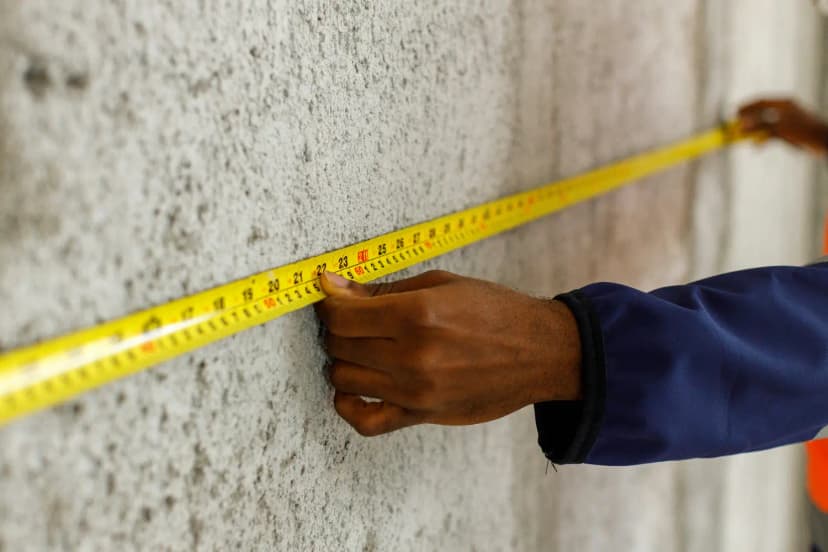
See gallery wall layouts with real sizes — 3, 5, 6, 8, 10+ frames. Match a Framky kit to your wall width, then hang with a 1:1 template.
Give it a try?
See how it works